
Key Points
INTRODUCTION
Progressive political parties face an uphill battle in the post-industrial towns of England and Wales.
The seats that Labour is projected to lose to Reform are disproportionately located in former mining and manufacturing areas, from the South Wales valleys to the Black Country to the northeastern coast. Even though direct Labour-Reform switchers are relatively rare, they combine with an energised Reform support base and a demotivated progressive bloc to shift the balance of forces across the UK, and nowhere more so than in post-industrial towns.
Despite their homes having become key electoral battlegrounds, discussions of the everyday lives, ambitions and political commitments of the residents of post-industrial towns rarely extend beyond tropes and truisms. These places are often cast as an angry, reactionary counterpart to booming, progressive cities. Certainly, radical right parties have made headway in post-industrial areas. But ethnographic research in these areas reveals a simmering economic radicalism and a popular appetite for progressive social transformation, which remain unfulfilled.
This project examines the lived experience of workers and residents in Mansfield, Corby and Coalville — three towns in the East Midlands with mining and manufacturing histories. All three are currently represented by Labour MPs and, according to current polling, all would be won by Reform if a general election were held tomorrow.
Through focus groups, in-depth interviews and long-term ethnographic work in these three Midlands towns, this project brings out facets of people’s lives and the places they live in that are not easily captured in surveys or soundbites. Progressives, we argue, face three main challenges: scepticism, salience and structural mismatches. We trace these traced through the lives of seven working-age residents of these three towns: Martin, Diane, Sinead, Jessica, Donny, Janet and Max. (Their names have been changed to protect privacy.)
Two of them voted Labour at the last elections, three voted Reform, one voted Green and one abstained. Almost all hold at least some progressive beliefs.
Any serious answer to these challenges must be based in the everyday lives of regular people, like those profiled here. With this insight in mind, this report identifies six principles to guide a progressive political project for post-industrial England.
Loss of trust in politicians and political institutions is lowering barriers to voting for the far right, while depressing turnout on the left. Stalling quality of life and stagnant local economies deepen the sense that politicians do not care.
Many people have progressive instincts in day-to-day life, expressing commitments to solidarity and redistribution of power. But workplace experiences of hardship and humiliation are under-politicised, while folk devils such as the deliberately undocumented immigrant are politically salient.
On many economic themes, residents of post-industrial towns express a profound radicalism. But objects of popular radicalism, for example the popularity of controls on supermarket prices, do not always match up with primary sites of profiteering in the economy.
Scepticism
The first major problem facing progressive political parties is the erosion of faith in politics and politicians. Where their subjective and objective class position once tied many of the residents of (post-)industrial areas to the Labour Party, a form of class consciousness now feeds a generalised disdain for politicians. Although this loss of faith spans the political spectrum, it has proven particularly harmful to top-down appeals to solidarity, as opposed to a politics premised on self-interest. A politician’s moral appeal for measures against child poverty, for example, rings hollow when they are thought to have enriched themselves at the expense of the public. Many interviewees said they did not intend to vote again.
The decline of high streets and town centres and a lack of stable, well-paying local jobs intensified the sense that politicians did not care. “I’ll be really honest like now”, one Mansfield interviewee said. “I used to vote Labour when I thought Mansfield was doing all right, but I haven’t voted in the last couple of years. Because I just feel that Mansfield is in such turmoil, I wouldn’t know who to vote for.”
In one of the Corby focus groups, an enthusiastic Reform voter and a left-wing non-voter found common ground in their shared sense that politics was corrupt. “Politics at a local level, most people still have good intentions”, the Reform voter said. “I think as soon as you hit a national level, you have the party mandate. So, they don’t care about the people. They’re not — they are not working for us anymore. Like if you don’t see that, then I — you must be blind. [...] If they worked for us, things would be different. Like completely different, wouldn’t they.” Across the table, another man was nodding along enthusiastically, before cutting in: “— eat the rich! [laughter] Take them out. Take down parliament. Blow it up properly, yeah, yeah.” The Reform voter continued: “Because, like I said, that — everyone — they get hit with that national corruption. The politicians at that level they are bought and sold. They don’t care what the —” At this point the other man interrupted again to express his agreement. “They don't care what people say, because the people ain’t funding them. [laughter] They care about the people that are giving them money.”
Many others around the table expressed agreement. “They’re crooked politicians.” “They just want to get into politics because it’s a guaranteed money train, isn’t it.” Even if not all agree that we ought to blow up parliament, a sense of corruption is rife. For many, the Mandelson-Epstein scandal will have confirmed what they already suspected: that politicians are primarily looking out for themselves and their cronies.
Where the far right can present itself as a radical alternative to a corrupt status quo, it is able to benefit greatly. “There’s nothing to lose [in voting Reform]”, said one focus group participant. “Even if they’re absolutely disastrous and absolutely diabolical, I don’t see how much different it can be. I think it’s pretty disastrous already to be honest. I do.”

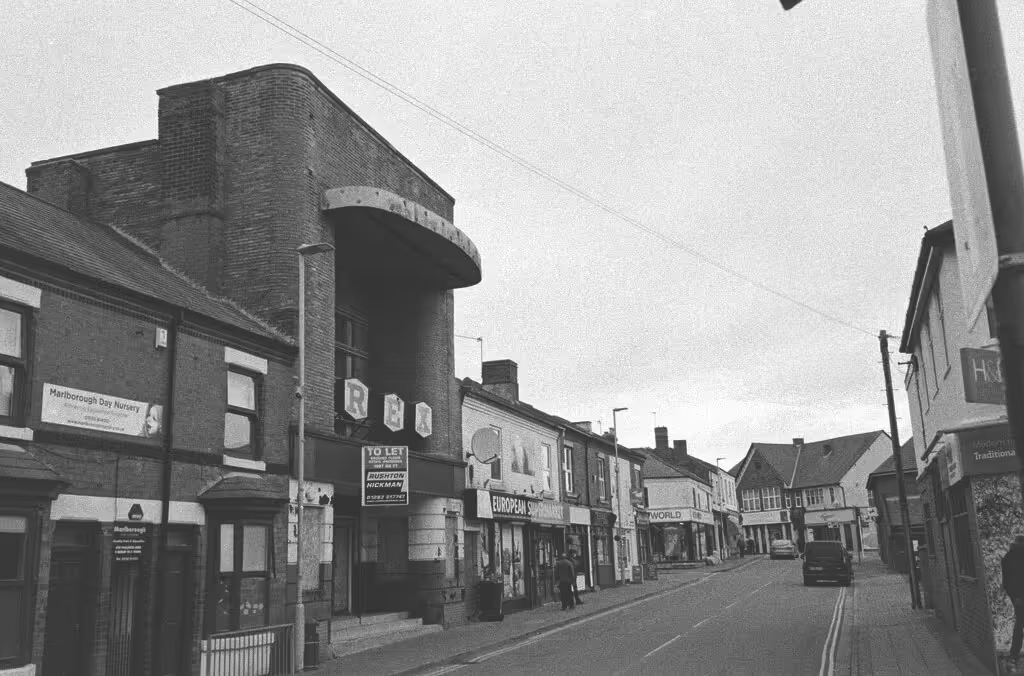

Martin and Diane
Martin, a white man in his 60s, grew up on the border between Derbyshire and Nottinghamshire and moved to the Mansfield area in his twenties, when he met his Mansfield-born wife, Diane. His father was a miner. Martin did not want to follow in his footsteps, because he saw the effects of mining on his father. “Working long hours, never seeing my dad. Rock falls, fall-ins, you know, conditions he used to tell me about, you know, working in red-hot heat, dust, water, just, you know, it wasn’t the life for me. But unfortunately, you know, I had to have it because there was nothing else. My dad said to me you’ve got to have work and that was it.” When his pit shut, he transferred to another, and when that one shut too, yet another. Some men would keep chasing the dwindling supply of mining jobs. But for Martin, it was time to get out.
He would head out to building sites to offer himself as a bricklayer, which had been one of his trades down the pit. “I would just say, ‘Yeah, I can brick lay this, that and the other.’ Then they said no because you haven’t got any paperwork, no qualifications. You’re like semi-skilled, as such, you know what I mean? Nobody would give you that chance. I found that; you’d got to retrain and have qualifications as well. No matter how good you were at that job.”
Eventually he found a job in horticulture. He loved being outside, but it only paid about half his previous wage. “It’s been instilled with me since an early age, if you work hard, you can have a better standard of living, better quality of life and, you know, like I say, you’re going to have a better life. Or you should do.” He believes in the inherent value of work. “Maybe it’s a moral thing and all.”
He has little faith in politicians. “They haven’t got a clue how we live, not a clue. They want to put in about six months doing what I have done in my working life, then they will realise how they do have to live, living hand to mouth and working hard [...] But they will never do that.” He does not see much point in even listening to what they say. “They say anything to fill their own pockets basically, to get the vote.” Martin and Diane had both heard stories about politicians’ perks and pay. “[T]hey have two houses, don’t they”, said Diane. “They have one in London and one in wherever they live.” Martin: “They give themselves massive pay rises, it is like thousands of pounds.” Diane knew that politicians’ salaries had now risen to £96,000 — an unbelievable figure to her. MPs taking on second jobs seemed like another example of them getting away with things any regular person would get fired for. Politicians did not seem to know or care how hard life had gotten for the rest of the country, or perhaps, Martin speculated, that was how they wanted it. “You are getting poorer actually, that is what you are getting — poorer. That is what they want.”
Like Martin, Diane was born into a coalmining family. Her father had been a miner, while her mother was often unable to work due to health problems. When her parents separated acrimoniously, Diane had to take on various jobs to support her. Those jobs often took a physical toll, whether bending and lifting all day to stack shelves at Superdrug or down on her knees to cut carpets at the flooring shop. When money was tight, Diane and her mother sold their jewellery. Later, when she met and married Martin, her finances improved and they were able to afford a mortgage. She had hoped to eventually work with young children in a nursery setting, but the only jobs going were working with teenagers with special educational needs and disabilities. “You can’t really pick your job, really. You have just got to do what you can.” Still, she met nice people and learned new things, like sign language. “So, it was alright yeah, I was quite alright with it. You can’t always have what you want can you, but you have got to take something else, haven’t you.”
Martin and Diane had hoped to have children, but it never happened for them. “I am glad now [that we didn’t], really”, Diane said, “with how things are in this country”. They are concerned about the decline of the area and the deterioration of the town centre as well as the loss of industry. “We have sold everything off; we have got no industries hardly now.” Both would like to see stronger renters’ rights and workers’ rights and public control of life’s essentials. Alongside these progressive priorities, they expressed concern about immigration and a sense that British people were not being “looked after”. But jobs were the priority. “I think they need to get more jobs, have sustainable industries”, Martin said. “That is the only way you make any money is through having industries and jobs.”
In 2024, both Martin and Diane voted Labour, mostly because they felt the country needed a change. Neither is happy with their choice. Diane: “He told a lot of lies, Keir Starmer. I would never vote Labour again. I don’t think I would vote anybody because they all lie, personally.” The change they had hoped for has not materialised and since the Winter Fuel payment cut, they are no longer willing to give the government the benefit of the doubt. “He has absolutely crippled working class people”, Martin adds. “You just get disillusioned, and you think that is it for me. I can’t change anything.” Martin is weighing up whether he trusts Nigel Farage enough to vote Reform. Diane has not quite warmed to Farage in the same way and feels he “goes on a bit”. She doesn’t think she will ever vote again. Martin: “I can’t believe any of them. [...] [But] if I ever would, I would probably vote Reform.”
Like Martin, several other participants in the focus groups were considering Reform and minded to “give them a go”. There was a strong sense that nothing else had worked – to make life easier and to turn the country around — so you might as well. But while the perception of corruption currently favours the radical right, it need not do so. Research has consistently found that calling attention to Reform’s donors and in particular their reliance on a small number of ultra-wealthy people tends to undermine support for the party. New rules on politicians’ conduct in office would also affect the party’s day-to-day operations. Reform politicians, and Nigel Farage in particular, would be significantly affected, at least in terms of their personal finances, by a second job ban on account of their lucrative GB News work.
Because political mistrust is so ingrained, half-measures will not win back trust and goodwill. Politicians often promise to restore standards in public life, before backtracking in office. Opposition from some politicians to radical anti-corruption measures would convey to the public that the proposals are serious. These measures could include: a second jobs ban; comprehensive lobbying reforms as recommended by the Committee on Standards in Public Life and the Public Administration and Constitutional Affairs Committee; placing the authorities tasked with overseeing lobbying and standards in public life on a statutory footing; and, in serious, Mandelson-type cases, stripping ex-ministers of their parliamentary pensions. Further measures could also include capping MP salaries at double the average full-time wage, abolishing subsidies for alcohol on the parliamentary estate, and placing a £200 limit on the value of permissible gifts and hospitality.
Martin and Diane see politicians as driven by greed above all else and felt powerless to make any change. As Diane puts it, “If you stand up for yourself, you could just get slapped down because you have got no chance against management or politicians.” In this environment, politicians cannot get a hearing with the public even on occasions where they do present thoughtful and popular policies. Anti-corruption presents a political opportunity, because it is a rare example of a policy area where action is salient, popular and just. In the long run, progressives must rebuild the connections between communities and their representatives and make the UK better able to curtail plutocratic power through financial reforms. An Anti-Corruption Act is a first step towards that end.


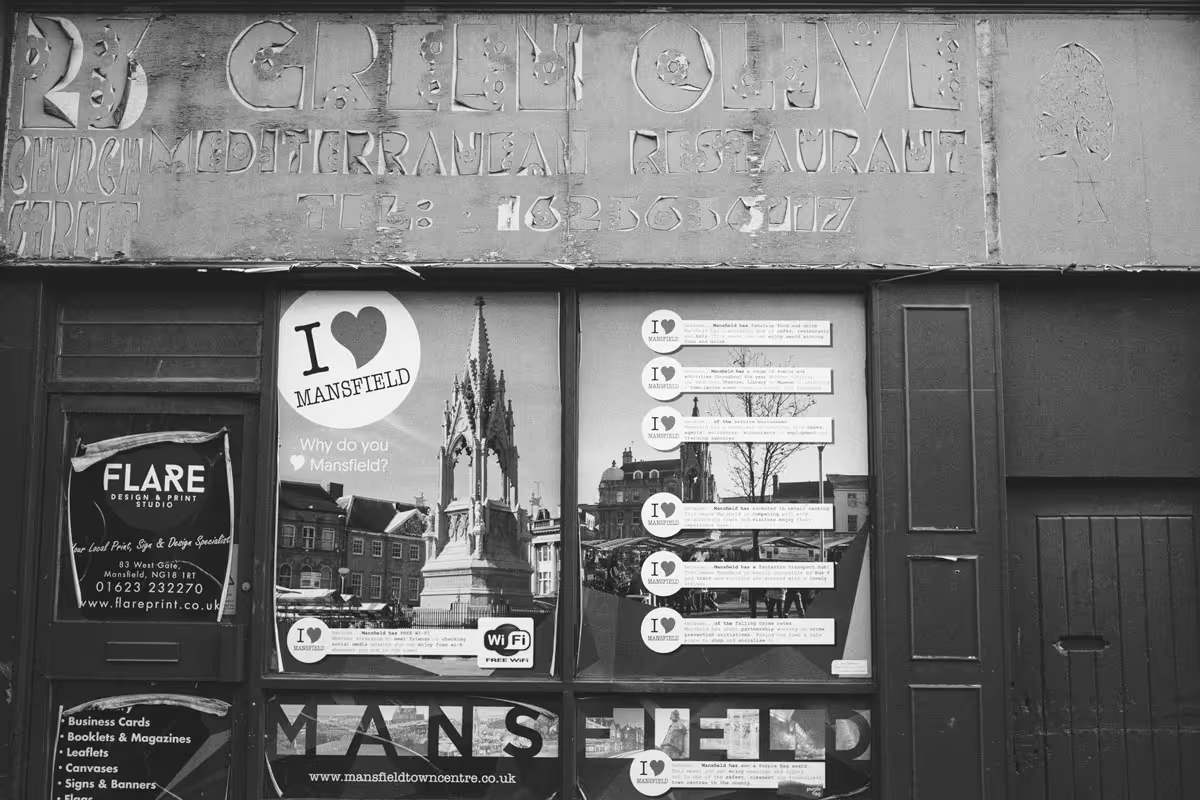
Sinead
Sinead's family moved to Corby from Ireland, which is a common migration story in the town. Growing up, the family spent a lot of time in and around hospitals, because Sienad's sister was born with cerebral palsy. “[Working in a hospital] was always a dream [career] to me, but I wasn’t academically good enough.” After finishing her A-Levels, she enrolled in a business studies course at De Montfort University in Leicester, but university life did not work for her. Her mother had not been doing well, and her sister needed more care, which contributed to the decision to quit her degree. While at home after dropping out, she spoke to the community carers who were coming in to look after her sibling. “I saw them coming in they had nice cars, little Audi A1s, they had nice hair, they looked happy, they had nice uniforms and I am just sitting at home just slopping about.” The community carers noticed and asked if she would like to come work with them. It paid better than many of the other jobs Sinead had worked. “They told me the wage and I was like, ‘Come on then.’”
Working for private healthcare providers for a few years, Sinead became increasingly disillusioned with the system. “I would be going into clients, sitting in their own piss and shit on my own. No support there, just on my own as a single call, 15-minute call. Five cats maybe, five cat litter trays around the place and delirious. I am ringing the company; I need to phone an ambulance. But, you need to get to Wilf in Weldon by half nine so make sure, phone them now so that the ambulance gets there quicker because you have only got fourteen minutes left in there. I am like, I am not leaving here.”
As she was promoted within the company, she got to see more of the financial side of the business, which shocked her. The higher-ups were making large sums, while workers were exploited and clients were neglected. “The problems were just always dismissed. The staff were never looked after. The clients were never looked after. There was just money, money, money, money, money, money.”
Eventually the care work burned her out and she stopped picking up the phone when her employer called. Maybe it was depression too, she is not sure. She went on to do construction work for a family member, working as a sub-contractor on jobs like block paving, slabbing, turfing and fencing. “Seven years, hard graft, on sites and freezing cold weather.” Then one day she was on the job, breaking out a driveway with an industrial breaker when her body gave out. In all her years on site she had never felt anything like it.
After a few days at home, she did a pregnancy test just to check. It came back positive. When Sinead told the company, she found out there were no provisions for maternity pay — she had been a subcontractor, not an employee. “It is not that type of business”, they told her. “I don’t know what the fuck you are going to do.” She was in shock. Her family supported her for a bit, then told her to go sign on for benefits. It was hard. But parenthood has been a blessing, and she continues to do a lot of volunteer work in the community. It has given her time to reflect. She has been healing, Sinead says.
She generally does not vote, though at the last local elections she voted Green as a favour to a friend. “Does my vote even count? Everyone is so sceptical of shit. Unless I physically see it, I can’t really believe it.” Sometimes she feels the government is just a “puppet on a string”, but then she doubts herself. “I haven’t got the education and so I don’t really know what would make me [believe in a political project again] … prove it to me man, change this country.”
It seems to her that society has gone badly wrong. “I am not just going to buy into the system that is completely fucking corrupt. I want to be far away from it as possible at the minute.” On the one hand there are people like the private care providers raking in millions, on the other there are people like herself and her loved ones, trying their hardest to make ends meet. “People aren’t paying their bills, and they aren’t buying essentials or luxuries because people aren’t going to earn enough.” In a cost-saving drive, one friend has started to ration how often he boils the kettle. “[H]e boils it once in the morning and fills his flasks because he doesn’t want to boil the kettle seven, eight times a day. Just a way you can save.”
Sinead's politics have been shaped by her upbringing, her love of travel and music, and her own and her loved ones’ experiences of hardship. She would like to see rent controls and stronger eviction protections, having seen a pregnant friend get evicted two weeks before Christmas. She is in favour of bringing essentials back into public ownership, though she is worried about the forces and interests that allowed for privatisation in the first place. “[G]overnments allowing that as well to happen is frightening, yes. Take back ownership – just all go Game of Thrones, pitchforks.” Sinead is the first to admit that her views and approach to life are different from those of many of her neighbours, but she feels very connected to her community. “I have never felt like escaping this town.” And the town has been there for her, too. “People love me for who I am. I am different and I am out there a bit they would say. But I am going to keep that hope that it can be …” She stops herself before she finishes her sentence. “It is a hard time, it is.”
Sinead's story points to the importance of an industrial strategy for social care to improve conditions for both those providing and those receiving care and the reversal of some of the privatisations that lock Sinead and so many others into paying a “privatisation premium” they can ill afford. Winning back Sinead's will require tangible changes close to home. As she said, “prove it to me — change this country.” The Kingswood area of Corby will be one of the recipients of the Government’s Pride in Place programme, which is a good first step. But to truly revive the town, it will require a new set of anchor institutions to replace those it lost with the demise of its steel industry. Past MPs had hoped to eventually attract a university to the town, but the current state of the university sector makes such plans unlikely.
There is, however, a tremendous need for training places for nurses. A big investment in nursing education would allow those who have gotten stuck in exploitative private sector care jobs to gain accreditation and expand their job prospects. Through partnerships with regional universities, new nursing colleges could be set up in towns like Corby that do not currently have a university. Beloved buildings that are currently sitting empty in Britain’s post-industrial towns could be taken into public ownership and retrofitted to be sites of learning. This would bring hundreds of future nurses into town centres, boosting the local economy and providing fresh energy to town centres that have been suffering from the decline of the high street.
Another potentially popular proposal would be the restoration of the nursing education bursary. In often difficult local labour markets, nursing jobs stand out as a viable and appealing pathway for many young people in post-industrial areas. The 2017 decision to cut the nursing education bursary has made training up more expensive and more difficult, while the NHS is left desperately short of nurses. A big investment in training places and funding for those who commit to working for the NHS for at least five years after they train up would offer a clear path for social mobility and help to ease workforce shortages.
Reviving post-industrial towns will require a combination of top-down investment in anchor institutions and bottom-up efforts to create inviting local spaces. Where absentee owners have let their high street properties sit empty and dilapidate, local government should be empowered to act and, where appropriate, help bring spaces into community ownership. Recent promising Government efforts to make land ownership data more accessible should be taken further by combining the register of corporate land ownership in England and Wales with spatial data on which exact land these companies own to make it easier to trace owners and hold them to account. Central government could and should provide local authorities with legal resources to fight negligent owners of local eyesores and foster community ownership.
The Kingswood and Hazel Leys Community Workshop in Corby is an example of what can happen when spaces are democratised and locals are given free rein to design them as they see fit. Founded by locals, run by volunteers and given stability by a long lease from the Council, it offers a makerspace with equipment for woodworking, 3D printing, laser cutting and more. Membership costs only £10 a year and £1 per session. Sinead loves this place, as do many others. Many locals have donated their tools. The man who had originally conceived of the plan for the space passed away before it was fully realised. Sinead: “But the community stepped up and was like hang on, he had a great idea, let’s carry this legacy on for him.”



Salience
A second problem facing progressives is that the political conversation has been dominated by issues where progressives are on the backfoot, most notably immigration and to a lesser extent the benefits system. The Government’s move towards a more restrictive stance have only heightened its salience, while many other policy areas were not as front-of-mind and lacked a sense of political possibility. Many interviewees regarded experiences of hardship and humiliation at work as an unavoidable fact of life. While most of the interviewees and focus groups participants held many progressive opinions, especially on employment, health and housing, these policy areas were not as central to their political identities and party-political preferences. Most were unaware of the measures the Government has taken on renters’ rights and employment rights, despite being strongly in favour of the policy content. Popular policy changes are not cutting through.
Our current media ecosystem exacerbates these dynamics. Across the different field sites, stories about alleged sex crimes by black and brown men circulated rapidly in the community, tapping into ingrained fixations around race, gender and sexuality. Some focus group participants had experienced worsening racism and harassment as far-right groups became involved in putting up flags and vigilante “public protection” efforts. Yet racism exists alongside deeply held commitments to fairness and equality and a working-class universalism. As one Corby man put it in discussing immigration to the town, “If you do the same job as me, if you sweat the same sweat as me, you bleed the same as me, you know, I have got a mountain of respect for you.”
In post-industrial towns as elsewhere, the salience of topics tends to differ by age and immigration was more common as a preoccupation for middle-aged and older voters. Younger generations in all three towns are more exposed to everyday multiculture, as those who immigrated to the UK from Eastern Europe in the mid-2000s are now of an age to have started families, with their children in school alongside the grandchildren and great-grandchildren of miners and steelworkers. Meanwhile, comparatively lower house prices continue to attract new residents from across the country, including non-white Britons who have been priced out of larger cities. While all three areas are still comparatively white, younger residents speak far more often about social interactions with non-white friends and colleagues than their older neighbours do.



Janet
Janet is a Leicestershire hairdresser in her 50s. One of the things that make her job special is the connection with clients, who come in for more than just a haircut. “Some women feel very alone, on a different level, and they think they’re the only ones going through what they’re going through. And, so, although I’ll never mention names, I can say, ‘You’re not on your own with that. There’s a lot of people.’” But it can be difficult to step away from work. Clients often text her on her personal number when she isn’t working and demand a quick response. Not being able or allowed to switch off was a common theme across the people we spoke to, whether employed or self-employed. For Janet, this difficulty is intensified by the care she feels for many of her clients. Especially for older and more vulnerable clients, she will not raise prices.
After working in salons for a long time, she decided to become self-employed almost a decade ago. Initially she relished the freedom and the flexibility, but the financial aspect has been tricky. As a homeowner and a business owner, Janet is under pressure from rising supplier prices and a mortgage she finds hard to afford. “I can’t remember the last time I had two weeks off because that’s just too big a deficit. And if I’m poorly, I’ve got to be really poorly, because I just don’t get paid. And, so, it feels a little bit now like I’m on a hamster wheel. I can’t stop even if I wanted to stop basically. I’ve got to keep going.” She feels there was no one else she could rely on.
On social issues she generally leans right, although she is in favour of greater eviction protections and possible rent controls (“Kicking people out for no other reason than you want to make more money is wrong”). She would favour a much harder line on benefits and immigration. Janet is adamant that her support for Reform is about a defence of Britishness, not whiteness. Nevertheless, she occasionally speaks about migrants in harsh and dehumanising terms. “Who are they? What are they bringing? They’re not doing anything. They’re just like leeches that are just feeding off us, and I just think it’s very sad that we’ve kind of lost who Great Britain is. And by being, saying ‘Great Britain’, I don’t mean the white British. I don’t mean that, of anyone that’s British, any colour that is British, you know, there’s all sorts of religions and colours of people that are British. But we are losing Great Britain, I feel, the values that we hold important.”
Many interviewees spoke at length about young men coming over and deliberately shredding their passports, so the British state cannot identify them. This folk devil —the deliberately undocumented immigrant — was hugely salient, with almost every committed Reform supporter in the interviews bringing it up spontaneously.
The argument that Reform does not offer serious solutions to Britain’s problems did not resonate with Janet, because she does not believe that any party does. “I don’t trust [Reform] to deliver on it. They’re saying the right things, but who is going to sort this mess out? And, unfortunately, I think we’ve gone too far. I don’t think it will be sorted out because I think there’s too many people under the radar that we don’t know where they are, who they are. I think the Universal Credit is too vast a job to get hold of. So, I just feel like we’re spiralling into a country of unknown really. You know, I do appreciate, I mean some people talk about mosques being built and all the rest of it. Well, we all need a place to worship, I accept that, that’s not a problem. But I don’t accept that in Birmingham English is the fourth [most] spoken language. Sorry, you’re in bloody England.”
This last fact is not true. The latest census data suggest that 84.4 per cent of Birmingham residents speak English as their main language, followed by Urdu as a distant second, at 2.28 per cent. Nevertheless, media outlets, such as GB News, have been promoting items about a supposed lack of English proficiency in Birmingham. Janet follows GB News on Instagram, which is how she gets some of her news. Her Instagram feed often presents her with stories that spark her outrage, sometimes of dubious veracity, about veterans arrested for flying the Union Jack, or benefit fraud, or allegedly impending sharia law. “I know it’s probably isolated, but the news is picking up on it.” Even if cherry-picked or pulled out of context, Janet feels the stories raise important points. "There are the fellows out there that think it’s right to chat up a nine-year-old girl. No! Not in this country.”
Stories like Janet’s are sometimes used to argue that the Labour Party must shift right to widen its appeal. But Janet is exceedingly unlikely to vote for a progressive party under any circumstances — in the parlance of political scientists, they are outside of her consideration set. Like everywhere else, post-industrial towns have their share of right-wing voters, and contrary to the myth of a uniformly Labour-supporting industrial heartland, always have done. Although the experiences of hardship of these voters deserve to be taken seriously, progressives should not kid themselves that small-business owners who lean right on both economic and social issues are likely to back their cause. Nevertheless, the current salience of immigration is undeniably a problem for progressives, as is the power of outlets like GB News, especially on social media.
In the face of widespread anti-immigrant sentiment, it can seem like the best progressives can do is to direct the attention of voters to other policy domains. But some red lines should be protected with vigour, as a matter of moral urgency. Any attempts to normalise a blood-and-soil nationalism must be called out and countered.
Like Janet, many voters on the right still strongly support the notion that people who are born in Britain are British, regardless of ethnicity. She is also firm in her view that people who contribute deserve to make a life here. Indeed, Government policy at present is more restrictive than the common-sense view that regular people who come to the UK to work regular jobs are welcome — not just high-flyers on above-average salaries.



Donny
Donny, a white man in his 40s, has experienced the lower-paid end of the Corby labour market. When a qualification in IT did not work out, he worked a series of jobs in retail, logistics and security. The older generation of industrial workers in town may have been occasionally sentimental about the value of toil for its own sake, but Donny doesn’t see the point. “I’ll always work just a little bit harder than the person that’s working the least [...] If everybody else is working hard, I’ll work hard. [But] if they’re not, then I’ll just... —I’m not going to kill myself for [it].”
In addition to low pay, his working life has been marked by a lack of autonomy, unpredictable shifts and managerial favouritism. In the food processing plant where he worked for a period, the ability to make a decent wage depended on earning output-based bonuses, which in turn depended on being assigned to one of the easier fruit-cutting stations, like pineapple. Donny suspected that the managers’ favourites were assigned to easy shifts where they could earn large bonuses, whereas the rest were stuck on difficult fruits like mango, where no one made much on top of their basic pay.
Although the details differed, concerns like these were raised across the focus groups and interviews. People hoped for a job with friendly colleagues, where your contribution was respected and the manager allowed you to “get on with it”. The best managers might pay for the first round at the pub on a Friday after work. Instead, many workers felt stuck in roles that burned them out mentally and physically, with little connection to colleagues, where managers would dismiss their input then blame them if things went wrong. Yet equally for these participants, as for Donny, there was little sense that such conditions could be changed. At best, you might change jobs and hope you got lucky at the next place. Some younger, male research participants fantasised about becoming wealthy enough to walk away from work, but again these were fantasies of exiting, rather than transforming the workplace.
When people did walk away from work, it was more commonly due to escalating caring responsibilities. Donny’s life changed when first his father and then his mother developed dementia. He was working in transport and logistics for the cosmetics company Avon at the time and asked to be put on the day shift so he could look after his father in the evenings. But the system was not set up for agency workers to make demands about shift times and before long he was moved to the back shift again. He quit his job and became a full-time carer; trying to survive on carers’ allowance. “It wasn’t too bad at the start, the first couple of years, three, four years [...] I had a bit of freedom so I could go and do my bits and bobs. And then it got to the point where we couldn’t do anything.” When his parents eventually passed, he was left with large utility debts and physical and mental health problems. “For the first year I literally just slept on the settee down here, never came out, I didn’t go upstairs [to my bedroom]. I didn’t do anything.”
Perhaps surprisingly given his experiences of exploitation in the labour market and abandonment in his care work, Donny’s political priority is ending small-boat Channel crossings. He blames irregular immigration for driving up taxes and creating issues in housing and labour markets. Above all though, his concerns attach themselves to race and gender. “Because it’s just males coming over isn’t it, for the most part. I think it’s the majority that you see anyway.” He believes the “cultural differences” are too large and he doubts the merits of applicants’ asylum cases. “I mean most of the places they’re coming from, yeah, there might be a little bit of a war going on or something but it’s not as bad as what they make it out.” The real motive, he believes, is access to benefits. He voted UKIP in 2015, Conservative in 2017 and 2019, then Reform UK in 2024.
It is unlikely that Donny will ever vote for progressive political parties, despite holding left-leaning views on some economic issues. Progressives should not assume that he might. Nevertheless, his story points to important terrain for them to contest. At present, immigration is far more politically salient than work. Although working lives are fraught with hardship, people’s critiques of working conditions do not always filter through into a manifest political belief or policy preference. This might be because it is hard to imagine that work and working conditions can change very much at all. While interviewees can picture changing jobs, or fantasise about becoming wealthy enough to retire early, they find it hard to imagine improving conditions where they are.
Part of the historical task of progressives is to repoliticise workplaces, inviting workers to see their working lives not as dictated by natural laws but as the result of an ongoing, contingent process of struggle. In a society such as ours, the conditions of our work determine to a significant extent the conditions of our lives. The UK’s legal regime makes it considerably harder to repoliticise work, but recent progress on employment rights offers openings. The Employment Rights Act offers important advances, not just by banning exploitative working practices but also by making it easier to win union recognition, by introducing the option for electronic balloting and by removing punitive legal anti-strike provisions.
Reform have promised to undo the Employment Rights Act if they come to power. A political fight over employment rights — and crucially one where people stand to lose rights they have already gained — would favour progressives, who should not only defend the provisions of the Employment Rights Act, but push further towards greater democratisation of the workplace. Crucially, the scope of negotiations must be broadened beyond pay, hours and holidays to bring the conditions into focus that the participants in this research project spoke about — humiliating management practices, lack of respect for personal time and impossible shift scheduling — into the purview of negotiations. Strengthening legal rights to negotiate on working conditions is a first step in a wider project to help restore a sense of possibility.



Jessica
Jessica is a nursing associate from Coalville in her 20s, who hopes to eventually become a registered nurse. One of her placements is on a mental health ward with patients detained under the Mental Health Act. On an average day, she conducts hourly checks on the patients, brings round medications and accompanies patients on walks around the grounds. She might also talk to their families or sit in on a ward review to discuss a patient’s treatment plan. Her other placement involves more personal care tasks — making patients comfortable, walking them to the bathroom and making sure they have the food and fluids they needed. Life on a busy ward is stressful, as there is always something that urgently needs doing. “You’re constantly on your feet; you’re never sat down.”
The work comes with its challenges, including a manager who seems to play favourites, occasionally patients that are challenging, and pay that has not kept up with the cost of living. “[W]e’re supposed to say we don’t do it for the money. But obviously, yes, there’s an element that we do it for the money, of course we do. Like me, I like my job, I like working in mental health so that’s why I’m still there.” She finds a great deal of intrinsic value in the work. “It’s very rewarding. Especially when you come in and you have patients that they’re at crisis point. So, them coming in and you building that rapport and helping them get back on their feet is rewarding.”
Jessica’s work with vulnerable people shapes her perspective on many social policy questions, including renters’ rights. “[Y]ou could have someone that has a learning disability, and it could be mild, it could be severe. They could have several concurrent conditions and they’re going to get kicked out in either a month or two. But they’re not going to find a property to get out. So that’s going to impact them significantly, do you know what I mean?” Similarly, she is strongly in support of the provisions in the Employment Rights Act. Practices like fire and rehire are abhorrent to her. “Bin that. Take that away.” At the same time, what she describes as “documentaries” she has seen about asylum hotels have strengthened her sense that immigration is out of control.
Jessica does not see herself as a political person. “I never usually have any [opinions]. I just sit still and look pretty”, she laughs. At the last general election, she voted Reform, but she is unsure now whether that was the right choice. She had been swayed by her sister, who was an enthusiastic Reform backer. “She said that voting for Reform was going to help her children’s future and I thought, right, OK, so I went along with it. Which probably I shouldn’t have. I probably should have done my research and see what was out there.” This was a common story among people in the focus groups, several of whom had voted Reform just because siblings or friends had urged them to do so. It speaks to the power of an enthusiastic, fired-up base to help mobilise others.
Progressives require policies that will similarly enthuse their base and raise the salience of the policy areas where they are more trusted. Rent controls, which enjoy high levels of support in the country and were popular in focus groups, are one example. In post-industrial towns, the private rented sector is much smaller than in larger cities and university towns, and those who do not go to university are more likely than their student peers to live with their parents until they can afford a deposit for a mortgage of their own. Nevertheless, support for renters’ rights and specifically rent controls is strong. Some focus group participants who were otherwise shy about their opinions in the focus groups felt confident making the argument for rent controls. “The people that do buy second properties and charge extortionate rent and stuff like that, that makes it even harder for us”, said one Coalville man in his 20s. “You know what I mean?”
Rather than obsess over the votes of those who have not and will not back their political project, progressives ought to firm up support and spark enthusiasm in the core of their base, which includes renters, younger people and many of those who work in the care economy. A commitment to housing affordability would place progressives firmly on the side of these groups and energise the base.



Structural Mismatches
A third problem facing progressives regards a mismatch between some areas of popular radicalism and the existing structure of the economy. Although it is true that significant parts of the British economy are marked by rentierism and, in some cases, excess profits, the price rises that people are angriest about are not necessarily driven by profiteering. The most notable example was supermarket prices. Almost everyone was able to rattle off a list of items and their escalating cost. Many focus group participants took a radical stance in favour of price controls on a basket of essentials. Even when told that such measures were highly unorthodox, would be opposed by many economists and might generate shortages, most supporters did not waver. “Look at Tesco’s profits and that will be an example of capitalism gone wild”, said one man in his early 60s. “[W]e’ve had the boiling frog analogy where it has been slowly, slowly, slowly and now we’re cooked. We’re cooked.”
Food price inflation elicited strong responses because it had hugely affected daily routines. “I just feel like it’s all in a rut. Like, I mean, I go down to Morrisons, do my shop, obviously I’ve got four children. So I go down for a meal, like one meal and it costs me twenty-five pound just for that one meal. So, I’m now at the point where I’m on the really cheap aisles of food. Whereas before I could get a shop that would last for about seventy pound a week. I don’t know… honestly, to be honest.” Others concurred. “I couldn’t imagine buying anything branded. And I haven’t done for years.” “I know. I can’t anymore”, said a third woman. She could no longer justify the expense. “Or just go into one supermarket”, said another. “I end up going to like, all different types of supermarkets depending on what’s on offer.”
Their paths through the supermarket had changed, as had their interactions with the products. They recounted reaching not for the items on the shoulder-height shelves, instead having to crouch down to retrieve off-brand budget items from the lower shelves. When the discounted products were put out, one interviewee said, people rushed in and the supermarket turned into “bedlam”.
Popular radicalism on food prices would seem like an ideal opportunity for progressives, but the structure of the food industry makes it harder to act on popular demand for drastic change. While there is much to criticise in the groceries sector, not least the growing role of private equity and the high market concentration in the provision of many everyday supermarket items, supermarkets themselves do not tend to have particularly high profit margins, as price competition is fierce. Supermarkets attract most ire because they are the site where consumers come face to face with rising prices elsewhere in the production process, just as train companies are the face of rising rail fares, when it is in fact the rolling stock companies which own the trains that are arguably the more significant site of excess profits.
This leaves progressives in a bind: some of the most salient areas of popular radicalism on prices are also those where there is less scope to act. To meet the moment, progressives will have to combine measures to reduce the cost of staples, for example by aligning more closely with the EU on food, with decisive action on profiteering and, in the longer term, developing a new macroeconomic toolkit to deal with price shocks while protecting jobs and living standards.
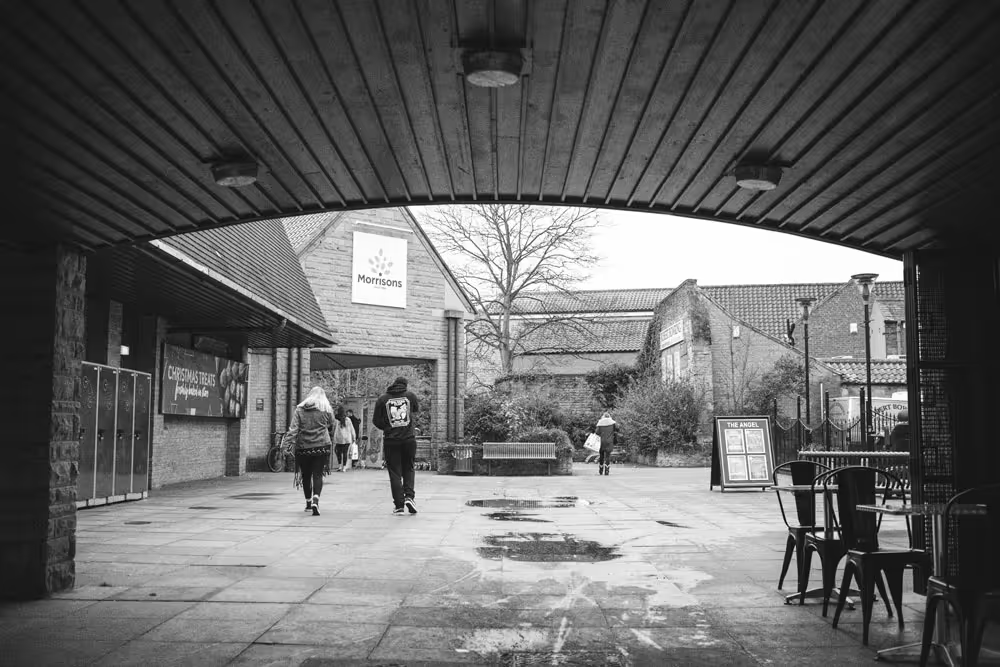


Max
For a long time, Max had hoped to join the RAF. Now in his late 20s, he grew up in a military family and spent the latter part of his childhood in Mansfield, where the military has, historically, been a way out for young men who did not want to go down the pit. After school he had initially trained as a plumber, but it was hard to get a start in his career because apprenticeships were sparse. Instead, he found himself working in a local factory. It was a job and it paid the bills, but not much more. The armed forces seemed like an appealing alternative. “It would be an excuse to go around the world, so rather than... it just seemed like a kind of a way out from being stuck in a bit of a dead-end job. [...] It's easy enough to get trapped in it if you let yourself. I see it happen to a lot of people.”
The factory job was monotonous but demanding, as small errors could halt the entire production line. There was not much opportunity to chat to colleagues, except during breaks, and the shifts were long. On days when he came in hungover, he would crank the volume of the radio up, trying to stay awake. “[Y]ou’ve got your break halfway through and then another couple of hours of pushing the buttons, making the notes, trying to stay really focused even as you’re getting increasingly tired, because a 12-hour shift is long.” He would just hope that the guy on the next shift who was coming in to relieve him would show up on time. Then a shower, a change and a visit to the gym. The gym is undeniably a place of joy for him. He is in good physical shape, as occasional Instagram stories of his workouts testify, and it is a place where he has made friends and found purpose.
He never attended university, but some of his friends did, as did his long-term girlfriend Emma. He spent a lot of time with her and their wider friend group as they worked through their courses, which gave him “a bit of that experience”. Emma is a practicing mental health nurse now and Max ended up retraining as a gas engineer when his dream of working for the RAF did not work out. Together, they have a decent income. Emma is a loyal Labour voter, but Max was not so sure, having grown up in a staunchly anti-Labour household. She was on his case about it, telling him to not be “an idiot”. He squared the circle by voting Green. They might not have stood much of a chance to win the seat this time around, but “[i]t is one more in their basket going forward.” And besides, he recounted with a big smile, he had relished outflanking his girlfriend on the left.
Max was driven to vote Green by his ethics rather than what he perceived to be in his self-interest. “I don’t know really what kind of impacts Greens would have for the working man, but I tried to put other things above it as a whole rather than [my own interest]. Just the social economy, I suppose. Being human, try and make the decision for the masses rather than myself. [T]hat's I think where the Conservatives do well, they’ve got all the people that want to make their life better voting for them. Whereas I don’t think my life’s that bad anyway.”
Max has a disparate set of views which span the political spectrum, but all in all, he feels society would be much better off if the Greens were able to enact even half their programme. The problem is “all a lot of capitalist greed I suppose [money is going to] like big oil contracts and military defence contracts and stuff like that, whereas there’s not as much being put into [the environment] and wellbeing and social structure.”
Many shared Max’s sense that excessive greed was one of the major problems in society today. This reflects the problems inherent in the UK’s economic model of the past 40 years, structured by privatisation, marketisation, austerity and the retreat of public provision of essentials, which has empowered a minority to realise runaway profits while life gets continually more expensive for the majority. Renewed inflationary pressures due to the US war on Iran make it simultaneously more difficult and more urgent to address the cost of living head-on. The war-induced crisis is likely to shrink the space for fiscal intervention to address hardship, at least in short term, but targeted support on bills for lower-income households through social tariffs will be essential. Rising bills and shrinking fiscal space also put a premium and urgency on interventions such as rent controls and collective bargaining that give working-class households more power and resources without direct public spending.
Alongside the slow work of adjusting our economic model — rebuilding state capacity, building out infrastructures for homegrown clean energy and bringing some of the sectors providing life’s essentials back into public ownership — restoring a sense of political possibility requires that political leaders visibly take on entrenched interests and make headway on the cost of living. While reform of essential sectors will not necessarily yield immediate cost savings, over time it will eliminate the regressive privatisation premium people pay to access basic services — and will show the Government is willing to take on powerful vested interests on their behalf.



CONCLUSION
A political project for post-industrial areas must start from the everyday lives of their residents, not the preconceived notions of faraway commentators.
The principal challenge facing progressive parties in England’s former industrial areas is not that residents have somehow got the “wrong” views, but rather that many no longer believe in politics at all, that their everyday workplace hardships have come to feel inevitable, and that areas of popular radicalism do not lend themselves to immediate transformative action. These are the problems of scepticism, salience, and structural misalignment.
Progressives can begin to overcome these by taking decisive action on political corruption; by transforming declining town centres with new anchor institutions; and by taking the fight to some of the most notable examples of what many see as an excess of greed in society today.
If life is tough, it also offers its pleasures, here as much as anywhere else. The interviews speak to Sinead's love of Corby’s community spaces, Max’s love of his local gym, and even Janet’s love of a glass of red wine after a long day of work.
“A lot of working-class people they don’t want a lot”, said Martin, the former miner turned horticulturalist, referring to himself and his loved ones. “They want enough to get by and to have nicer things in life. To go on holiday and to have good food and things like that. They are not bothered about yachts and aeroplanes — not in my eyes, anyway. They are just happy enough to get through in life with a job, a secure job to pay the mortgage and to look after their family and take nice holidays. At the end of the day, that is what I think. When you have got peace of mind with that, you can’t beat it.”
Credits
This project was generously supported by the Alex Ferry Foundation. Immense thanks are due to Keiran Goddard and everyone at AFF for their support. The authors would further like to thank Victoria Hughes and Anki Deo for their comments on an earlier draft. They are also grateful for the support and input of the whole Common Wealth team and particularly Amelia Horgan, Sarah Nankivell, Mathew Lawrence and Sophie Monk. Finally and most importantly, this project was made possible by the people of Mansfield, Corby and Coalville, who were kind enough to share their perspectives.
Where photographers other than Sacha Hilhorst and Nathaniel White have been credited, images have been sourced from Geograph and Flickr and licenced under Creative Commons (see photo captions for licences).