Very British Problems
Summary
Three developments in recent weeks shed light on Britain’s international outlier status as regards to its approaches to energy security and grid development. One suggests that the UK’s stubborn allergy to public control is being overtaken by events. Another shows the UK’s stance becoming even more exceptional internationally. The third concerns emerging narratives about whether fragmentation and miscoordination are a feature or a bug in our energy system.
Rough but Not Ready
Britain once more faces a self-inflicted threat to its energy security. The government and Centrica — the owners of Britain’s biggest gas storage facility, Rough — are yet to agree a subsidy deal to keep it open. Britain’s gas price (National Balancing Point or NBP) has been mounting without sustained interruption since June of this year and is currently at its highest level since December 2022. Meanwhile Rough has been sitting “practically empty” throughout the crucial April-October injection season pending an agreement.
Centrica has already closed Rough, in 2017, which sharpened Britain’s exposure to the 2021-23 gas crisis and prompted an emergency partial re-opening in late 2022.[1] “If the market doesn't think it makes sense — neither does the government”, was supposedly the policy thinking. Defence Minister Luke Pollard’s pronouncement last week struck a more antagonistic tone against Centrica but the logic was similar to Kwasi Kwarteng’s nine years ago: whether to close or not is “a very clear commercial decision for the company”.
The dangers of Britain’s current approach to storage were anticipated long ago. The 2009 Wicks Report highlighted Britain’s concentrated exposure to one major field and “urged that very careful consideration be given to the case for strategic storage as an insurance policy in an uncertain world.” Next year, Ofgem’s Project Discovery concluded the same based on a series of stress tests that included a war between Russia and Ukraine. DECC ruled out strategic storage as too expensive a solution to such a remote risk.[2]
These risks are no longer remote. The Rough case presents a clear opportunity to emulate widespread European practice and take public control of a demonstrably strategic asset, of which unsubsidised private provision is demonstrably untenable. It is also a test of whether the UK is capable of acting on foreseeable risks. In any case, events may soon force the government’s hand.
The Great Reinvestiture
The Portuguese state recently reacquired a fifth of its transmission operator REN — Redes Energéticas Nacionais, SGPS, S.A.. Having privatised its grid in stages between 2000 and 2014 — most decisively during the 2012 Eurozone crisis — the state holding company Parpública bought 13.7 per cent on 8 September 2026 and another 5.3 per cent on 12 October 2026. This follows the German government’s reacquisition of 25 per cent of its transmission operator Tennet Germany through state bank KfW in July.
This is a noteworthy development because, until recently, Portugal was one of only three OECD countries (with Britain and Chile) to have entirely privatised their energy grids. Portugal and Britain alone had the combination of privatised networks and unbundling of distribution from retail. Portugal shared with Britain the peculiar position of its networks being owned more by foreign governments than by its own — in their case by China’s State Grid. The primary stated motivation for reacquisition was sovereignty, public interest, national security and geostrategy, but a secondary motivation was also to “increase the state's ability to ‘influence from within’ investments aimed at expanding REN's electricity grid, speeding up connections”.
Similarly to the acquisition of southeast England’s distribution network operator UK Power Networks from CK Group by France’s 22.64 per cent state-owned Engie, the acquisition does not seem on first glance to have met with any adverse reaction from sovereign bond markets at all. Portuguese yields followed the same path as comparator countries. Nor did REN’s stock price suffer; Engie’s rose upon news of acquiring UKPN.
We should not read too much into the micromovements of financial markets, but the absence of obvious market reaction speaks at least to the separability of the public corporation’s balance sheet from that of central government and the policy space that that opens to governments willing to take initiative. In any case, this development leaves the Britain even more of an outlier than before.
Whence Fragmentation?
A narrative is emerging among some defenders of privatisation that the current miscoordination and fragmentation should not be attributed to privatisation, but only to policy missteps in the last decade or so, which threw us off course. On this view, real privatisation has never been tried. One such misstep, on this view, was the 2015 abandonment of the strategic network plan for 2020 put in place by the 2009 Renewables Strategy. This is said to have given us the unfinished grid upgrades from that plan, which, in turn, gave us the farce of wind farms being paid to turn off.
This claim echoes a common refrain whereby the ownership question is a distraction from, and is orthogonal to, more important failures of regulation and governance. But it is worth considering how much sand privatisation has thrown in the gears of the desired plans and governance principles.
The “market-led approach” adopted in 2015 replaced the 2009-15 Connect and Manage regime (which derisked generation investment by offering plants connection dates without waiting for network reinforcement), which in turn replaced the preceding Invest and Connect regime. For one thing, the motivation behind then Energy Secretary Amber Rudd’s pivot, getting “government out of the way as much as possible”, is hardly out of step with privatisation’s motivating logic. As Nigel Lawson set out in 1982, “I do not see the government's task as being to try to plan the future shape of energy production and consumption”. The Energy Networks Strategy Group (ENSG) set up under C&M, co-chaired by DECC and Ofgem, was disbanded in 2017.
At the same time coordination problems spanned both these regimes. The NAO’s recent report on upgrading the transmission network shows how the two Eastern Green Link lines necessary to relieve constraints on offshore wind took 15 years between initial proposal in 2009 and Ofgem approving funding in 2024 ( six years after EGL1’s initially proposed delivery date). Figure 7 in the report shows a timeline of the ordeal. Much of this delay was attributable to the endless back and forth in scrutinising the projects’ “needs case”, much of it before Rudd’s market-led pivot.
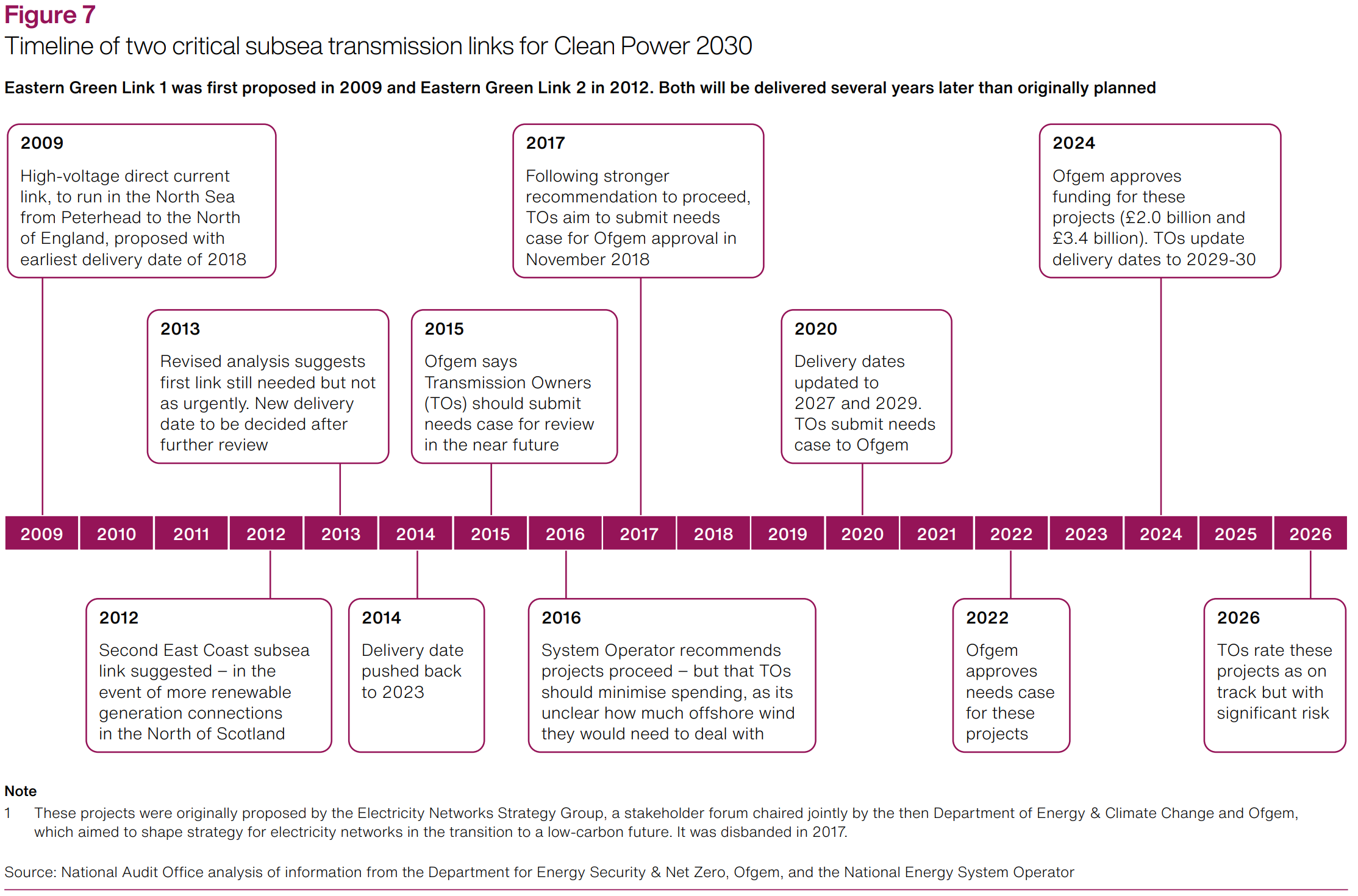
I contend that this back and forth is more of a feature than a bug. Far from being reducible to regulatory overreach, it is the result of fragmentation imposed by privatisation between actors whose interests too easily diverge and who lack a shared understanding of system need. The regulator that has to pick its poison between systematic overspend or systematic underspend — between the capital bias of the Averch-Johnson effect (operators building unnecessary and expensive projects to bloat the asset base to juice regulatory returns) and the alternative of systematic underspend of allowances. The process of scrutiny is made on the one hand clumsier and ineffective by the way in which information is lost when crossing organisational boundaries. On the other it is made more urgent and high-stakes by the erosion of trust between the parties.
Indeed, architect of monopoly privatisation Stephen Littlechild more recently described the interminable negotiations attending each price setting process as “like purgatory”.[3] Chief water lobbyist David Henderson favourably compares the more constructive relationship between the public corporation Scottish Water and its regulator WICS (Water Industry Commission for Scotland) to the adversarial relationship between Ofwat and the English and Welsh companies. For decades Ofwat’s approval process has led to cyclical fluctuations in water investment plans every Asset Management Period that impede long-term capital projects and throttle supply chain development.
Low trust is not some historical accident but rather the result of decades of financial engineering and regulatory gaming arising from a fundamental principal-agent problem. In the energy networks’ case it was by systematically overestimating investment needs and then underspending the elevated allowances and pocketing most of the difference. This pattern stretches beyond decarbonisation and Amber Rudd’s market turn all the way back to privatisation, spanning different regulatory frameworks from RPI-X to RIIO-2. National Grid Electricity Transmission underspent its £1.6 billion capital allowance by 45 per cent from 1993 to 1996. Transmission operators underspent on load capex by 20 per cent in 2013-21 and 12 per cent in 2021-25, with work “delayed, scaled back, reprioritised or moved into later periods” in the NAO’s words. RPI-X was designed as a lightweight circumvention of the information asymmetry problem; RIIO tried to overcome it through brute force. Neither succeeded.
The nationalised industry’s historical track record with transformative megaprojects looks very different. The CEGB’s 275kV “supergrid” was built in 1952-60 on schedule and under budget — generation and transmission were incidentally planned, built, owned and operated together.[4] The conversion from town gas to natural gas — decided upon in 1966 following the 1965 North Sea discoveries and executed from 1967 to 1977, also on time and under budget — was a similarly impressive undertaking made easier by close government coordination, vertical integration and by households interfacing with one entity. Notably it was resilient to the five changes of government during the process.
So, why is the system so vulnerable to policy flip-flopping today? One reason may be that the flip-flop concerns differing political attitudes on how best (and whether) to manage the needs, expectations and incentives of external actors on whom public policy is nonetheless reliant.
It is worth quoting Dan Davies, who draws on the neglected tradition of management cybernetics theory to make sense of the palpable erosion of UK state capacity in the administration of public services, and proposes three laws to underpin a better approach. “Second law: Boundaries between and within organisations should be minimised wherever possible. Adversarial boundaries, where communication has to take place between parties with opposing interests, should especially be avoided”. This seems like an apt description of regulating privatised natural monopolies.
Decarbonisation has seen fragmentation proliferate within the public sector too. Transmission planning is now spread across DESNZ, Ofgem, NESO, the National Infrastructure Commission, a Networks Commissioner and Clean Power 2030 Mission Control.[5] We seem to respond to every new problem by creating a separate new planning entity, like some grotesque parody of the Tinbergen Rule.[6] The NAO pointed out that NESO lacks the resource to fully model the financial impact to consumers of grid delays. The Electricity Networks Programme (ENP) has been established to oversee grid upgrades and monitor strategic risks, but “while accountability for individual projects rests with the Transmission Owners, no single person is accountable for delivery of the portfolio as a whole”. The ENP Board and Clean Power Unit rely on informal influence in the absence of powers. Accountability and information too easily slip through the cracks.
The extent of miscoordination that we see today was not made inevitable by privatisation, but it was made considerably likelier. Britain’s experiment in unbundling and privatisation went further than any other country and many of those that followed our example have started turning back. The recent announcement of a public owned GB Grid, able to compete in tenders for new lines, is a small but promising step in the right direction. But in gas storage, in transmission and in the marginality of our public financial institutions, we remain a continental anomaly.
[1] The effects go beyond the mere failure to smooth gas prices seasonally. A recent UCL study also highlights a circuitous channel through which Rough’s closure sent electricity prices even higher than otherwise in 2022: with Europe cut off from Russian gas, Britain’s UK's abundant regasification capacity made it the conduit for US LNG into Europe, but lack of storage capacity meant we were regasifying the LNG faster than our interconnectors could transmit it to Europe, driving a wedge between GB and EU gas prices. This wedge, along with French nuclear outages, made it more profitable for Britain’s gas power plants to export electricity to France than sell here domestically. In other words, our marginal price of electricity was frequently being set by French gas prices elevated by Rough’s closure — a key node in this Rube Goldberg machine of immiseration.
[2] Project Discovery’s main policy legacy was the push to accelerate renewables deployment. In the event, the mechanisms chosen — Contracts for Difference and the Capacity Market — relied on billpayer subsidies. Exposure to gas shocks remained.
[3] “Indeed, it is worse in this respect than the apparently heavy-handed US regulation that it was intended to replace. A concern about US regulation that Alan Walters and I had back in the 1980s was that, although most US rate cases were dealt with routinely within a year or so, occasionally some cases could drag on for two or three years. And now we have a situation where, for all UK regulated water and energy network companies, the price setting process routinely takes about five years, is indeed an ongoing never-ending process. It is like purgatory – ‘a place or state of temporary suffering or misery’ – except that it is no longer temporary: it is a place or state of permanent suffering or misery. “And yet regulators remain optimistic. Press Release from Utility Regulator Sisyphus: ‘I am pleased to announce today that I have finally rolled this price control boulder to the top of the hill.’”
[4] A recent Boston Consulting Group report credits the Chinese system’s vertical integration with “further shorten[ing] project timelines by simplifying coordination between generation, transmission, and grid connection.”
[5] The unbundling of distribution from retail also creates a conflict of interest for system operators when choosing between network build or demand-side flex that better utilises existing network. Distribution planning is further impeded by the UK’s missing jurisdictional layer between councils and the nation.
[6] Davies again: “As new problems arose which did not match up to the organisational boundaries which had originally been designed, ‘joined-up government’ got more and more difficult.”
