
An authoritarian coalition is embarking on a power grab unprecedented in recent US history. This coalition, led by President Trump and a network of aligned oligarchs and backed by the institutional right (e.g. The Heritage Foundation and the Federalist Society), has found little resistance in Congress or the majority of the Supreme Court. The coalition is taking significant steps to concentrate power in the presidency itself, in the executive branch as a whole, and in the network of politically aligned oligarchs and giant corporations that already dominate our economy and democracy.[1] Using Project 2025 as a blueprint,[2] the result of the authoritarian coalition’s approach is to elevate and empower those who are aligned with the administration’s interests, and to impose discipline against claims for progress and power from everyone else.[3]
The administration and the authoritarian coalition it leads has taken a hammer to broad swathes of laws, norms, and policies in the first year of its second term. This includes:
Experienced together, these changes can be overwhelming and hard to make sense of. At first glance, the pressure campaigns the authoritarian coalition has waged on law firms and universities, increasingly violent immigration enforcement, and historically large tax cuts for the ultra wealthy paid for by healthcare cuts seem like unrelated actions.
In this paper, we suggest that each of these policy moves is not simply about the policy itself, but about the consolidation of power in the authoritarian coalition as a whole. To understand this power grab, we must disentangle and highlight the distinct but interlocking levers of power that the administration and its authoritarian faction are using to consolidate control. We argue that these key levers are: political and institutional power, cultural and narrative power, and economic power. These levers are tools that can be used to advance democratic or authoritarian aims. The overall aim of the current authoritarian consolidation is to reinforce a cultural, economic, and political hierarchy where only those considered deserving by the authoritarian coalition can participate in a pay-to-play mafia state where power is bought and sold. In this paper, we discuss an alternative way forward.
[.box][.box-header]Three Levers of Power[.box-header][.box-paragraph]Political and institutional:[.box-paragraph][.box-paragraph] The authoritarian coalition has consolidated power in the presidency to shift the balance of state capacity away from provisional uses towards coercive uses.[.box-paragraph][.box-paragraph]Social and cultural:[.box-paragraph][.box-paragraph] The authoritarian coalition is weaponizing social and cultural notions of “deservedness” to advance white Christian nationalism and a culture of exclusion.[.box-paragraph][.box-paragraph]Economic:[.box-paragraph][.box-paragraph]The authoritarian coalition is deepening wealth concentration to reinforce an economic hierarchy while Trump himself is asserting a new form of control through a system of pay-to-play dealmaking.[.box-paragraph][.box]
The administration’s use of interlocking political, social, and economic power to seize and entrench authoritarian control has the potential to outlast the current administration unless pro-democratic actors explicitly reject this power grab and reclaim power for everyday people. When people neither believe in the state’s ability to provide and protect, nor do they believe in the ability of civil society to challenge state overreach, it creates a vacuum for authoritarians to exploit with control and domination.
In this paper, we trace how the administration and its allies are using these levers to achieve this power grab. It is precisely because an authoritarian coalition is working along all three of these lines that it has been successful in consolidating control over key institutions and shifting people’s relationship with the state and each other. Building a popular and durable pro-democracy coalition to push back against these realities requires policy makers and advocates to grapple with this power grab as a cohesive and powerful political strategy. As such, we offer a framework for how these levers might be leveraged to build a more inclusive and durable democracy. Crucially, a firm commitment to universality and inclusion is necessary to counteract the administration’s authoritarian project, and must run throughout the project of reconstructing our democracy in a post-Trump era. Without explicitly naming the goal of true pluralism, pro-democracy actors will be left vulnerable to the next authoritarian power grab.
The authoritarian coalition uses three distinct but interlocking levers to consolidate power: political and institutional, social and cultural, and economic. It is the intertwining of these efforts that results in a potentially durable new equilibrium where political and institutional power is shifted toward the executive branch; cultural power is shifted towards white, Christian men; and power within the economy is further shifted towards the wealthy-and large corporations, especially those aligned with the administration’s authoritarian aims. The authoritarian right uses these three levers as a part of a cohesive strategy to consolidate control in the hands of President Trump — at the expense of everyday people.
[.box]The authoritarian coalition has consolidated power in the presidency to shift the balance of state capacity away from social provisional uses towards coercive uses. [.box]
Putting more control in the hands of the executive means that one person’s whims can have the full force of the government behind it. It also opens the door for naked self-enrichment, such as the massive windfall the Trump family has enjoyed by selling crypto currencies.[6] Such behavior reinforces the “pay-to-play” nature of how the authoritarian coalition is using political consolidation in the executive to prioritize political allies at the expense of everyone else.
The Trump administration has leveraged Office of Management and Budget director Russell Vought’s vision of a unitary executive as a guiding framework.[7] In this proposal, the traditionally non-partisan civil service would be “gutted and repopulated with presidential loyalists” while independent federal agencies are “politicized or eliminated” and “absolute control of the executive branch [is] concentrated in the Oval Office.” Astable, merit-based civil service system ensures that the government serves public interests and ensures continuity even during political transitions.[8]
The initial efforts by the Department of Government Efficiency (DOGE), led by Elon Musk, to slash the federal workforce is a clear example of how the administration is breaking down the capacity of the state that provides services and serves the public interest, and consolidating power in aligned political actors. Political scientist Adam Bonica found that DOGE disproportionately targeted agencies that have regulatory functions or administer benefits — while preserving or enhancing coercive elements of the state.[9] During the first two weeks of the Trump administration’s second term, DOGE functionally eliminated the US. Agency forInternational Development (USAID), laying the blueprint for the further dismantling of agencies that do not serve the president’s personalist agenda, such as the Education Department and the Commerce Department.[10] In September 2025, over 150,000 federal employees left the government after taking deferred resignations initiated by DOGE.[11] In cutting $420 million from NASA, DOGE not only slashed public capacity for an innovative space program, it effectively transferred that capacity to Musk’s SpaceX company. Cutting pro-public aspects of government, in other words, supports the consolidation of power in political allies of the president.
The Consumer Financial Protection Bureau (CFPB), too, is a particularly telling case of the ways that the administration is putting the unitary executive theory into practice. The CFPB is a public watchdog established to go after big companies and banks that are exploiting everyday consumers. Under former CFPB head Rohit Chopra, the bureau went after everything from overdraft fees[12] and junk fees[13] to medical debt.[14] Under the second Trump administration, the agency is now under the leadership of Vought, who has been forthright in his intent to shut the CFPB down.[15] In this transfer of leadership, the administration has kneecapped the CFPB’s essential regulatory services as well as its independence, putting it directly under the control of the executive branch.
Slashing state capacity on the regulatory and provisioning side is also paired with the build up of the coercive elements of the state. This is most apparent in the vast expansion of domestic policing under the moniker of immigration enforcement. The One Big Beautiful Bill Act (OBBBA) gives federal agencies $170 billion for federal immigration enforcement — with the largest share going to Immigration and Customs Enforcement (ICE) and Customs and Border Protection (CBP).[16] ICE now has $85 billion with little to no accountability or guardrails;[17] by contrast, the 2025 budget request for the Department of Labor was only $9 billion — about one tenth of what ICE has at its disposal. The president has used immigration enforcement, as well as the public backlash against immigration enforcement, to increase military and policing presence in cities that he perceives to be political opponents. In Minneapolis, Chicago, Los Angeles, Washington DC, and many other cities and states, widespread immigration raids have disrupted families, workplaces, and resulted in clashes between agents of the state and everyday people, including the tragic shootings of Renee Good and Alex Pretti. We explore the expansion of immigration enforcement more deeply below.
The way that the administration is using the political and institutional levers has also advanced the goal of defining in-groups and out-groups. The administration has wielded new power by the executive branch to protect and advance political allies and those considered worthy of support — usually white, male, Christian, and often wealthy. This turbocharged executive power is also being used to constrain and attack the power of those not deemed deserving of resources, best exemplified in the unrelenting attacks on immigrant communities.
[.box]The authoritarian coalition is weaponizing social and cultural notions of “deservedness” to advance white Christian nationalism and a culture of exclusion.[.box]
Longstanding narratives about who should have power and wealth in society and who does not can be weaponized to advance a society that elevates white, Christian men. Telling a story of grievance and vilifying those who are deemed undeserving — e.g. immigrants and transgender people — is a powerful vehicle for building a political constituency that is rooted in exclusion. Importantly, anyone who opposes the administration’s agenda is also excluded from the benefits afforded to the in-group — simply being white and male does not protect one if they are misaligned with the political, cultural, and economic priorities of the administration.
If more people and groups are locked out of power by virtue of their race, gender, immigration status, or wealth, administration-aligned oligarchs and political allies can extract more and hoard resources and power. The cultural project of exclusion, therefore, is a core part of how the administration and its allies are consolidating power and wealth. While narratives about who deserves power in society and who does not can have political and economic implications, these stories are reinforced and advanced through a range of channels including popular culture, fads and trends, and policy administration, making it distinct from institutional and economic levers.
The administration and the broader MAGA coalition have reinforced narratives of deservingness, defining who is entitled to safety, security, and wealth. The administration has forcefully used state power to devalue the safety and humanity of immigrants (as we discuss further below.) The MAGA right has also concerted effort to elevate the status and power of white, conservative Christian groups, especially men. In one clear example, the Labor Department waged a social media campaign depicting a workforce dominated by white men. Implicit in such a campaign is that men, especially white men, belong in the best jobs in the workforce, while women belong in the domestic sphere.[18] More recently, the administration has escalated its rhetoric, directly referencing white nationalist images and ideas.[19]
Perhaps the clearest example of this project of exclusion is the dismantling of 60 years of civil rights law by weaponizing “diversity, equity, and inclusion” (DEI) practices that became popular in the early 2020s after the murder of George Floyd. Turning the concept of civil rights on its head, the administration is violating fundamental rights that have given people of color, people with disabilities, women, and others a better shot at having an equal footing in society.[20] The administration is making the perverse argument that white Americans are exploited by civil rights laws that are designed to provide equal protection under the law. The dismantling of civil rights laws accomplishes the dual purpose of diminishing the power and agency of those whom they wish to exclude, as well as actively advancing the power of those they wish to include in their project of power.
The administration’s thesis statement about who deserves to be in power is also explicitly advanced through their own appointments. The administration has replaced Black civil servants from agencies as varied as the Library of Congress to the Joint Chiefs of Staff with white, predominantly male, appointments.[21] The administration has also notably brought high-profile lawsuits against New York Attorney General Leticia James, and Federal Reserve Governor Lisa Cook, both Black women. The Department of Justice Civil Rights Division and the Equal Employment Opportunity Commission are investigating companies and law firms for perceived discrimination against white men, using civil rights law as a cudgel to force private sector businesses to align their hiring decisions with the authoritarian coalition’s notions of deservedness.[22]
These actions atomize people, generate fear and distrust among out-groups marginalized by this perspective, and normalize a hierarchical society where groups deemed deserving by those in power enjoy basic privileges such as safety, in contrast to those who are not deemed deserving. These actions offer a pathway forward to more specific power consolidation in the hands of the executive, and reinforce the notion that in-group members have access to the pay-to-play mafia state that rests on Trump’s personalist presidential power and amassed state power. Exclusion provides economic benefits for the authoritarian coalition as well — locking people out of power and resources paves the way for in-group members to lay claim to them.
[.box]The authoritarian coalition is deepening wealth concentration to reinforce an economic hierarchy while Trump himself is asserting a new form of control through a system of pay-to-play dealmaking. [.box]
In many ways, the authoritarian coalition relies on longstanding efforts on the right to concentrate power and wealth at the very top. As we explore below, the power consolidation in our economy is exemplified by the passage of OBBBA, which gave trillions of dollars of tax breaks disproportionately accruing to the ultra-wealthy and giant corporations. Those tax breaks were paid for by slashing critical programs such as Medicaid and food assistance benefits for everyday people struggling to get by. Using the tax system to structure an economic hierarchy is not new, and it is notable that in both the first and second Trump administrations, large tax packages favoring the ultra-wealthy have been the primary legislative achievement.
Deepening wealth concentration has important social and cultural implications. Neoliberalism has long offered a scientific veneer to the virtues of concentrated economic power and the exclusion of those who are deemed “undeserving.” A massive transfer of wealth from the poor and middle-class to the ultra-wealthy, as we saw in the OBBBA, reinforces the idea that only those who are deemed deserving by elites should be able to access economic security. This locks millions of Americans out of wealth and power, and establishes a clear economic hierarchy grounded in both material realities and in the social and cultural sphere. Policies that reinforce already yawning inequality bolster the notion that power, wealth, safety, and dignity are only for those who can pay for it. This has the dangerous effect of demobilizing individual and collective political demands — if everyday people know they have no agency in a democracy or economy, there is less of an incentive to exert the effort to change the system towards one centered on inclusive democratic and economic rights based on dignity and equity.
However, it would be incomplete to simply point to traditionally neoliberal methods of power accumulation. The administration’s economic agenda also relies on the personalist nature of the Trump presidency, shaking up traditionally neoliberal approaches at the whim of the executive. Many of the hallmarks of the second Trump term — weaponizing tariffs in ways unprecedented in recent memory, arbitrary regulation that changes without much predictability, and taking golden shares in companies — boil down to funneling power towards the presidency, often in ways that create incentives for other parties to offer up wealth and power in fealty.[23]
Trump has raised $300 million for the construction of a White House ballroom, his pet project, from companies and individuals seeking political favor;[24] some are lobbying for favorable regulatory policies, some enjoy lucrative government contracts, and some have recently faced lawsuits brought by the federal government. Similarly, Amazon paid $40 million to the Trump family for the rights to Melania Trump’s self-produced biopic documentary, which the New York Times reports was about $26 million more than the next closest bidder, Disney.[25]
Aside from bog-standard extractive self-enrichment, Trump’s erratic approach to tariffs embodies the pay-to-play approach that characterizes his administration. Trump wields tariffs to bully, intimidate, and make his bargaining position known. By upending traditionally staid approaches to tariff negotiations, Trump forces his political adversaries to the table on his own terms and extracts concessions. Take the first deal that the US. signed after the sweeping “Liberation Day” tariffs, which was with close ally and trading partner the United Kingdom. The “framework” agreement reached in May 2025 largely kept the baseline Liberation tariff rate of ten percent and came down from 25 percent to ten percent on a limited quota for vehicle imports for the UK. However, the UK continues to battle tariffs as high as 25 percent on key inputs such as steel.[26] As Labour Party MP Liam Bryne reflected on the deal, “we can’t escape the truth that Britain now trades with its biggest partner on terms that are worse than the past, the EU has in places secured a better edge, and key sectors of our economy still face the peril of new tariffs. That means jobs hang in the balance and investment waits on certainty.”[27]
Trump’s tariff policy also gave him leverage over his idiosyncratic desire for the United States to own Greenland. As the Council on Foreign Relations writes in their summary of Trump’s unpredictable tariff policy, “On January 17, 2026, Trump threatened to impose a 25 percent tariff on European countries over a lack of support for the US. purchase of Greenland. In response, the European Parliament paused action to approve the framework deal.”[28] As the New York Times reported, these tariffs were used to bring trading partners to the table in order to serve Trump’s self-stated psychological needs. When asked why he felt it was important for the US. to own Greenland, he said “Because that’s what I feel is psychologically needed for success.”[29]
Trump’s tariff policy is emblematic of a new form of economic power that bucks traditional neoliberal approaches in service of his own power and wealth. This creates a wedge between acolytes of a traditional rules-based and predictable economic approach and those who see the path to power scattered with offerings to Trump’s whims. Some business leaders are protesting behind closed doors, while others are hoping to make their fortunes by hitching their prospects to the Trump wagon.[30] If prepared, a progressive, pro-democracy coalition has the opportunity to exploit this rupture among capital in a post-Trump era to advance a new economic order that serves the workers, consumers, and families who keep our economy going.
[.fig][.fig-title]Figure 1: The Authoritarian Power Grab[.fig-title][.fig]
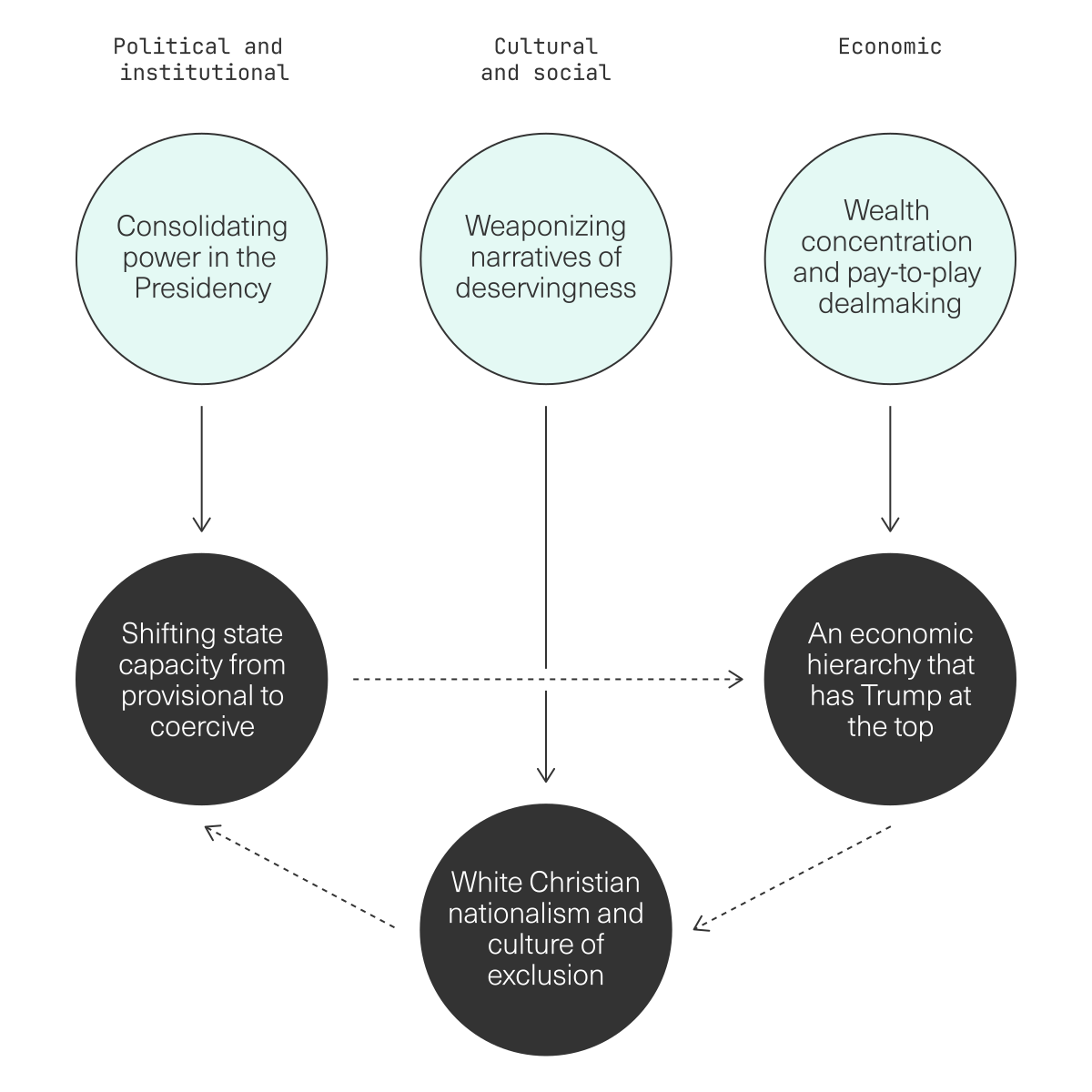
[.notes]Note: Dotted lines show how these outcomes reinforce each other.[.notes]
The following sections explore two illustrative case studies: immigration enforcement and tax and budget policy.
Under the auspices of the second Trump administration, ICE has seen unprecedented expansion. Going back as far as Trump’s first campaign for the presidency, immigration enforcement has been a central plank of Trump’s identity and brand. In this section, we highlight how the widespread campaign to empower ICE and vilify and dehumanize immigrants are two sides of the same coin to consolidate political power in the executive and establish clear societal hierarchies.
Within the first year of the second Trump administration, there has been enormous expansion in domestic policing capacity, predominantly through ICE.[31] ICE raids are widespread, and opposition to ICE raids is being used to justify militarization in cities like Minneapolis, Washington DC, Portland, and Chicago.[32] ICE officials are operating with broad impunity — their identities are often hidden by masks, and they have repeatedly arrested US. citizens and others outside of targeted operations. As a result of OBBBA, ICE now boasts a budget larger than many militaries around the world,[33] and as some have noted, effectively functions as a paramilitary force or secret police accountable to the president.[34]
The administration is also taking steps to decrease Congress’s oversight power over immigration policy.[35] The Department of Homeland Security, which oversees ICE, changed its policies for congressional visits. Whereas before, oversight visits could happen unannounced, the new rules enact a one-week notice period before congressional visits to ICE facilities and detention centers. This significantly weakens Congress’ oversight authority over an agency that is ever more closely tied to President Trump himself.
The administration is also leaning on state partners, such as Florida governor Ron DeSantis, to erect unregulated detention centers for migrants.[36] In these detention centers, detainees face inhumane living conditions, allegedly don’t have access to attorneys, and are being held without charges.[37] Hundreds of migrants in these facilities have gone missing or fallen out of official databases, a clear picture of how the administration is empowering alternative coercive elements of the state at the expense of established judicial pathways and proceedings.[38]
Immigration enforcement also advances the administration’s cultural agenda. The administration’s approach reinforces the idea that some people are deserving of safety, security, dignity, and wealth, while others are not. The administration has publicly said that it wants to deport one million people,[39] focusing on “dangerous criminals” in the first year of the Trump presidency.[40] However, as many have noted, the scale and speed required to achieve this level of deportations is nearly impossible, and in order to achieve this policy goal the state has engaged in widespread violent arrests based on race, ethnicity, language, and type of workplace.[41]
Many people who are in the country with documentation, along with citizens, are being swept up in immigration enforcement arrests. Not only has the Supreme Court paved the way for such racial profiling, the constant threat of ICE raids has destroyed the safety and security of millions around the country.[42] These occur in schools and community spaces with the visual imagery of masked ICE and CBP agents picking people off the street. The shootings of Renee Good and Alex Pretti by immigration enforcement officers in Minneapolis have further shattered the sense of safety for anyone who opposes these immigration raids and the way in which they are being conducted. These actions have allowed the administration to broaden the definition of a class of people who have limited rights relative to the “legitimate” members of society from the “criminal” immigrants they have long vilified to anyone who opposes the administration.
Widespread immigration raids also have implications for people’s relationship to the state and society. New surveillance technologies are being deployed quickly and potentially permanently shift the balance of power in the social contract.[43] Many immigrant communities have endured years of punitive and racially profiled policing, and immigration raids simply represent a continuation and escalation of these longstanding dynamics. But the ratcheting up of violent enforcement has qualitatively changed people’s relationship with their communities. In Minneapolis and other cities with militarized immigration enforcement, immigrants — document and undocumented — have withdrawn from public life, relying on neighbors to bring them food and keeping their children home from school. Around the country neighbors have put their bodies on the line to prevent immigration enforcement arrests and protect vulnerable members of their community, planting the seeds for more collective demands for universalistic safety and dignity. As movement leaders look to the future, there is an opportunity to leverage this organic solidarity in building power for everyday people.
[.box][.box-header]Three Levers of Power[.box-header][.box-paragraph]Political and institutional:[.box-paragraph][.box-paragraph]Immigration enforcement is a prominent part of Trump’s brand, closely associating this coercive state power with the president himself; less congressional oversight of detention facilities allowed, weakening congressional authority relative to the executive branch.[.box-paragraph][.box-paragraph]Social and cultural:[.box-paragraph][.box-paragraph]Immigration enforcement is being used as a tool for defining who deserves safety and “belongs” and who does not; the tragic shootings of protestors broaden the out-group definition to anyone who disagrees with the administration’s policies[.box-paragraph][.box-paragraph]Economic:[.box-paragraph][.box-paragraph]Immigration enforcement was initially justified using economic arguments around the availability of jobs; enormous slush funds for ICE paid for by cuts to healthcare and social services.[.box-paragraph][.box]
The administration’s efforts to consolidate political, cultural, and economic power are also evident in the administration’s tax and budget policy. The administration is using traditional economic tools, such as tax cuts for the wealthy, to further consolidate power for the ultra-wealthy and advance cultural narratives that define in-groups and out-groups. But the administration is also doubling down on novel uses of state power to further consolidate power in the presidency. In parallel, it is rewiring state infrastructure, such as the and the Internal Revenue Service, to entrench an authoritarian orientation no matter who is in power.
The first strategy is evident in the administration’s signature legislative achievement, OBBBA. At its most basic level, this bill guts Medicaid and programs such as food assistance to pay for immigration enforcement, detention, and deportation funding as well as enormous tax cuts for the wealthy. It is, as many have noted, the largest transfer of wealth from the poor to the wealthy in US history.[44] The extractive nature of this policy in service of the wealthy is self-evident, but the mechanism by which cutting Medicaid is accomplished — work requirements — is equally as important. Work requirements create onerous burdens on the people who have the least, and many experts have noted that they are functionally a backdoor to push people off of government assistance.[45] Work requirements are deeply rooted in racist and sexist narratives that offering assistance to poor — especially Black — people creates dependencies on the government that are immoral and anti-American. This narrative is best exemplified by the myth of the “welfare queen,” advanced by Ronald Reagan.
Following in a long-tradition of right-led tax breaks for the wealthy and big corporations, using tax policy to consolidate power and define in-groups and out-groups is not new.[46] However, the scale of the wealth transfer, the reinforcement of cultural narratives that exclude poor people of color, and the way resources are used to bolster a violent arm of the state loyal to the president is emblematic of how even the most traditional economic policy tools are being used in this moment to consolidate power across all three of the described levers.
The administration is also moving much more aggressively to consolidate power across the three levers in their approach to tax enforcement. The Internal Revenue Service (IRS) was eviscerated as a part of Elon Musk’s DOGE efforts,[47] especially resources to audit ultra-wealthy tax evaders — about 70 percent of the cuts at the IRS affect enforcement.[48] A weaker IRS will result in a significant reduction in the revenue that the IRS can pull in, and weaken the ability of the government to provide for the public good. Critically, the gutting of the IRS also serves as an important social and cultural signal: failing to crackdown on wealthy tax cheats is a way to signal that the wealthy are immune from the burden of shouldering public obligations.
The IRS has been an important node of attack not only because it supports healthy, pro-democratic state capacity, but because the tax collection and enforcement apparatus is one of the main channels of distributing power across society. By taking control of this apparatus, the administration can weaponize it to crush accountability for tax evaders, starve pro-public policies, and turn it into a surveillance apparatus that works only for the executive. As Anisha Steephen writes:
They don’t want to just dismantle the IRS. They want to further rewire it, transforming a civic institution into a political instrument. In this vision, taxation is no longer a shared obligation but a mechanism of ideological enforcement. Surveillance becomes the method, and loyalty to the president the metric. This transformation is rooted in the logic of new public management — a technocratic framework that reshapes public institutions to resemble private firms: lean, automated, data-driven, and detached from democratic accountability. This shift doesn’t just weaken the IRS. It bypasses the democratic infrastructure that’s supposed to govern it. What was once a chain of accountability — from lawmaking to enforcement to public benefit — is now being rerouted through executive command and algorithmic control. Under this model, the IRS ceases to be a steward of fiscal democracy and instead morphs into an engine of information extraction: surveilling the public, enforcing hierarchy, and concentrating power.[49]
Finally, the administration has further eroded democratic checks and balances and created the opportunity for a more pay-to-play style of politics through its budgetary policy. The administration has steamrolled over congressional control of the purse — sometimes with the explicit endorsement of Congress itself.[50] In July 2025, Congress abrogated its own power by conceding to a recissions package that clawed back funding for the Corporation for Public Broadcasting and foreign aid at the behest of the administration.[51] In other cases, the administration has simply moved to negate congressional appropriations. After DOGE took an axe to the agencies and programs that had been funded by Congress, the Office of Management and Budget (OMB) Director Russell Vought floated the idea of using impoundments — defined by the Government Accountability Office as “[w]hen the President (or any officer or employee of the executive branch), through action or inaction, delays or withholds enacted funding” — to make those cuts permanent without returning to Congress.[52] The legality of The Impoundment Control act, the main legislation that governs the use of impoundments is likely to end up at the Supreme Court.[53]
[.box][.box-header]Three Levers of Power[.box-header][.box-paragraph]Political and institutional:[.box-paragraph][.box-paragraph]The administration has kneecapped congressional accountability and in doing so, opened the door to more pay-to-play politics. The IRS, an institution that serves as a lynchpin of the democratic social contract, has been eviscerated and shaped as a weapon for the executive to use against the public.[.box-paragraph][.box-paragraph]Social and cultural:[.box-paragraph][.box-paragraph]Inherent in the OBBBA’s design is embedding age old narratives of deservingness on the basis of race and class. The IRS’s diminished capacity for enforcement gives the wealthy a free pass while the broader public foots the bill for militarized immigration enforcement in their communities.[.box-paragraph][.box-paragraph]Economic:[.box-paragraph][.box-paragraph] OBBBA is the largest transfer from the poor to the wealthy in US. history; less tax revenue and recissions starves pro-public programs.[.box-paragraph][.box]
The power of what the pro-authoritarian faction has done — in just the first year and change of this administration — is in its creation of a system where simply undoing a set of policies will not revert us back to our democratic normal. Rather, every lever — political and institutional, social and cultural, and economic — has been sharpened as a weapon to sustain authoritarianism and fight against democracy. The pro-authoritarian coalition has created a self-sustaining system in which each policy decision further embeds an authoritarian orientation and power consolidation that encompasses all of these levers.
Across the political spectrum, policymakers and advocates are calling for a much needed focus on affordability. This is critically important: a society with deep and structural inequality cannot support a healthy democracy.[54] However, it is not enough. The pro-democracy coalition must bring an equally multifaceted approach to policy, one that takes into account the importance of all three of the levers we discuss throughout this paper. Without reclaiming social and cultural ideas of the value of a just and pluralistic society, we will never be able to undo the deep economic inequality that has plagued our country for decades. Without tackling the state capacity and other institutional factors that serve as a headwind to progressive economic policy, we will never be able to empower the vibrant, multi-racial democracy we all deserve. Without firmly committing to addressing the outsized economic power held by the ultra-wealthy and mega corporations, we will never have the types of political institutions that work for the people instead of the wealthy.
Power building that effectively contests the authoritarian coalition’s power grab cannot rely solely on upholding norms and institutions that have failed to protect and provide for people in the past. It is not enough to simply have a policy framework that serves as a counterpoint to the authoritarian coalition. The authoritarian coalition has been effective precisely because they have been able to leverage a moment in which endemic instability in people’s material conditions and experiences as political actors has collided with an anti-institutionalist fervor. This interaction has allowed the authoritarian coalition to offer solutions rooted in autocracy and a deeply coercive state.
The pro-democracy project, then, is to depower the institutional weapons the authoritarians are wielding against us, all while bringing new, proactive approaches to the table to advance quickly towards a just, inclusive democracy. The approach must take into consideration the interplay between these three levers of power and bring a fresh sensibility: one that can effectively meet the deep policy challenges, and also acknowledge and take seriously the deep instability and disaffection with the system pervasive in our politics right now. It is time for new coalitions, rooted in the reality of people’s lived experiences and bolstered by an effective movement infrastructure, to effectively translate between the everyday and the policy sphere.
[.fig][.fig-title]Figure 2: A Durable Democratic Equilibrium[.fig-title][.fig]
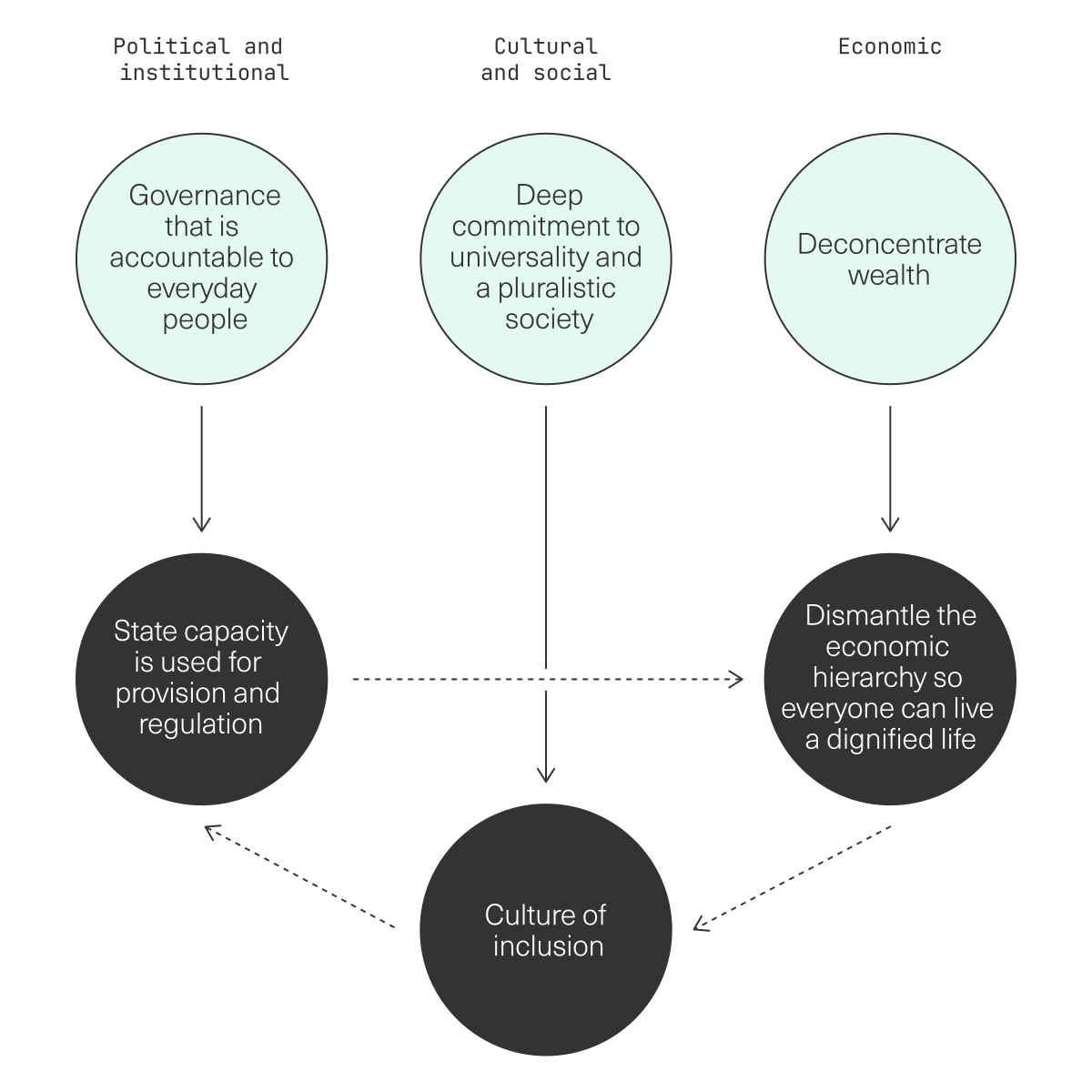
[.notes]Note: Dotted lines show howthese outcomes reinforce each other.[.notes]
Just as the administration and its allies have laced our political institutions with an authoritarian orientation — e.g. dismantling and retooling the IRS for surveillance — the pro-democracy coalition must do the same. The pro-democracy coalition must approach any reconstruction phase post-Trump clear-eyed about (1) the damage that has been done to the ability of the state to enact pro-public policies; (2) the weaponization of the state against the public; (3) the resulting erosion of trust in institutions spanning our democracy, from the three branches of government, to the media. Critically, this means both dismantling authoritarian state capacity and looking at our institutions with a fresh lens to build durable pro-democratic power.
The pro-democracy coalition must be prepared to quickly build institutions that facilitate democratic feedback loops so that it can gear up quickly to enact pro-public policies. Building out pathways for effective and efficient public participation in rulemaking, for example, will be critically important in both ensuring that agencies are working in the public’s interest but also in building back lost trust in institutions that are currently weaponized against them. Similarly, there may be an opportunity to take a fresh perspective on institutions that have long thwarted the public interest. Institutions such as the US Federal Reserve, which has long prioritized the stable prices side of its dual mandate over its full employment mandate, may be institutionally weaker in a reconstruction period and therefore ripe for a truly pro-public reimagining.
Depowering the coercive implements of state violence and the concentration of power in the executive is a critical element to building a state that actually works for the public and rebuilding public trust in institutions. For example, reinstating the Consumer Financial Protection Bureau as a truly independent agency that addresses consumer protection issues and is not under the thumb of the executive is low-hanging fruit. More complicated are projects like dismantling and then rebuilding an effective data infrastructure: DOGE did immense damage to data collection, created privacy issues by de-siloing and mishandling[55] sensitive data and the symbiotic relationship — bound by data — between the state and private corporations, as with Palantir and ICE.[56]
For both the proactive efforts to build effective pro-democracy institutions and the efforts to undo the harm done by the pro-authoritarian coalition in this period, the pro-democracy coalition must keep its eyes firmly on how to use these policy moves to pull one or more of the levers we lay out above. How can state capacity be designed to affirm an economy where everyone can thrive? How can state capacity cultivate a culture of inclusion that is then refracted back into the functioning of the state? Taking an interlocking approach will ensure a much more resilient and durable state that is more immune to future authoritarian pressures.
A steadfast — and explicit — commitment to universality and inclusion is critical to counteract the concentration of cultural power under the Trump administration. The potency of the cultural agenda of the authoritarian is not just that it is backed with effective state power, but that it is very clear about who it seeks to support and who it seeks to suppress. There is a risk that elite tolerance for exclusionary actions remains concerningly high, even as the broader public overwhelmingly rejects this approach.[57] Certainly, there is currently a debate happening on the right about the degree to which white supremacist elements are permissible within the party structure.[58]
The pro-democracy coalition cannot concede that exclusionary politics have a place in the multiracial democracy and just economy we are working toward. Thus the work to effectively advance true cultural pluralism has to be explicitly named. History is a helpful teacher for what happens without an explicit commitment to universality: the agricultural and domestic worker carveout in the New Deal has been copied and pasted on policies across decades, and a large and growing group of workers misclassified as independent contractors today continue to feel the echoes of that carveout.
Failing to embrace an affirmative politics of inclusion will hinder many of the pro-democracy coalition’s bold policy ambitions. The effectiveness of policies like universal healthcare or an effective childcare infrastructure rely on advancing a social and cultural approach that truly leaves no one behind. Doing otherwise will leave our economy and democracy vulnerable to authoritarian pressures in the future. As we have written elsewhere, economic instability and inequality can be exploited by an authoritarian coalition to offer solutions that rest in the strong arm of the authoritarian leader. The only path forward to building a truly inclusive, multiracial democracy and economy that is resilient against authoritarian pressures is to resist the temptation to means-test or otherwise replicate social fractures of the deserving and the undeserving.
The pro-democracy coalition must be willing to aggressively break up and regulate concentrated power to ensure that everyday people are empowered in their day-to-day lives. It is clear that taking on corporate power is both popular and effective. During the Biden administration, the Federal Trade Commission blocked predatory hospital mergers, took on powerful tech companies, and banned junk fees that exploited regular people in service of corporate profits, and polling has found that these actions were incredibly popular.[59] Similarly, state-level efforts to ban price gouging in New York[60] curtailed big corporations’ ability to exploit their market power over everyday consumers and have delivered material benefits to regular people as a result.[61]
Tackling concentrated wealth and power is critically important for the health of our democracy. Entrenched inequality makes a society vulnerable to elite capture generally, and authoritarian capture specifically. The accompanying loss of trust in institutions and more entrenched in-group and out-group dynamics create vulnerabilities that would-be authoritarians can exploit. Concentrated wealth also creates a system where power is bought and sold. Citizens United unleashed a tidal wave of money in our electoral processes that has only continued to escalate, journalist Anna Massoglia finds that: "Dark money groups, nonprofits and shell companies that spend on elections without revealing their donors, plowed more than $1.9 billion into [the 2024] election cycle, a dramatic increase from the prior record of $1 billion in 2020."[62]
In addition to using antitrust and regulation to break up concentrated power, the pro-democracy coalition should be bold in experimenting new ways of building alternatives to it, such as public options or universal public provision of essentials[63]. For example, the concentrated nature of our media ecosystem creates the conditions for authoritarian capture — it is much easier for a would-be authoritarian to demand the fealty of five oligarchs than it is to control the news output of a much more diversified system. As Bilal Baydoun, Shahrzad Shams, and Victor Pickard have argued, massive public investments in a free press — while not a complete solution — is an important tool for breaking up concentrated power, ensuring that the information that is critical for a healthy democracy is accessible, creating public interest standards, and imposing accountability on platforms that have escaped regulation[64]. Universal programs clearly have a strong appeal: proposals to make buses free and childcare universal have been met with widespread support in contexts as dissimilar as New York City and New Mexico.[65] Without essentials like food, housing, healthcare, information and transportation, it is nearly impossible to be a full participant in the economy and our democracy.
The authoritarian coalition’s power grab has been effective because it has used policies to tell a story about who is to blame and how a strong executive and a coercive state is the solution. The pro-democracy coalition, too, can use policymaking as a storytelling opportunity about who these new coalitions prioritize. Pro-democracy coalitions must pick policy battles that build channels for power and tangibly affect people’s lived reality.
For example, in response to widespread concern about unsustainable healthcare costs the Biden administration and Congress capped the out of pocket costs for insulin to $35 for those enrolled in Medicare, affecting an estimated four million seniors.[66] While the cap itself didn’t tackle the deeply oligopolistic nature of insulin manufacturing — three companies control nearly the entirety of the insulin market[67] — the Biden administration also empowered the Federal Trade Commission and the Department of Justice to address market concentration that resulted in such high prices in the first place. Policy approaches like this not only directly address people’s concrete needs, but they also generate a constituency for continued outside pressure. These types of feedback loops are critical for an accountable democracy, materially reducing economic instability that creates vulnerability to authoritarian pressures, and building a political culture where people see themselves as actors with agency.
Movement leaders and organizers are on the front lines of communicating with everyday people about how to exercise their power. Policymaking must be in dialogue with material conditions — not just in a superficial way, but through deep, trusted relationships that can advance change. Sam Rosenfeld and Daniel Scholzman have written about the hollowing out of this type of reciprocal infrastructure on the left. As they write:
The politics problem (a hollowed-out party incapable of shaping the landscape around it) and the policy problem (a vast policy-industrial complex that imagines itself to have electoral juice it actually lacks) reinforce each other as they fail, together and separately, to forge a politically generative project resonant with voters. Unrooted party organizations cannot reach an alienated and disorganized working class. Policy entrepreneurs who have identified the failings of neoliberalism cannot reach them either.[68]
Part of addressing this challenge is institutional: progressives must consider how to implement effective policy feedback loops that lay out a pathway for further wins, constituency building around the win itself, and shifts the power dynamic in favor of everyday people.[69] For example, the National Labor Relations Act, which established private sector workers’ right to unionize, has opened up power-building opportunities for workers across the economy. Effective policy feedback loops require intense investment in mezzo-level institutions like unions, community groups, and nonprofits, especially after the decimation of many of these groups over the last several decades.
But key to addressing this challenge is also taking the challenge itself seriously, and applying a reconstructionist mindset of the coalitional infrastructure to ensure that there are real feedback loops between policies and the people they are intended for. Policies like the Medicaid and SNAP cuts in HR 1 will affect broad swathes of the public from across the political spectrum.[70] Having close dialogue between the policymakers who are pushing back against these policies and the organizers who are doing the work to build coalitions around their harms will be critical in leveraging key policy fights to build a healthy pro-democracy political ecosystem. To generate trust, policymakers must also make sure that they are addressing people’s day-to-day concerns while addressing the underlying structural issues that lead to those problems in the first place and advancing a structural universalistic vision of their amelioration.
We are at a pivotal moment in the United States’ history. Without understanding how the pro-authoritarian coalition has used three interlocking levers to consolidate power, it will be impossible to build something better. It is critical that pro-democracy advocates don’t instinctively revert to rebuilding the very same institutions that allowed this authoritarian power grab in the first place. Our project at this moment is to use these same levers – political and institutional, social and cultural, and economic — to build a state that can be effectively deployed to advance an inclusive, durable democracy that is resilient against future attempts at an authoritarian power grab.
That requires us to tackle concentrated power wherever it lurks, ensure that we are meeting people’s lived reality with concern and care, and build a movement and policymaker partnership that grows power. An explicit commitment to universality and inclusion is critical in order to build a state that is designed to entrench and advance a healthy democracy. There are seeds of new thinking already breaking ground: New York City mayor Zohran Mamdani has demonstrated that universalist, redistributive and civic-egalitarian politics have widespread appeal. The powerful resistance to violent and militarized immigration enforcement raids demonstrates the potential to coordinate and build political force in such a moment. The task before us is to bring together these disparate threads of a new agenda into a force that can respond effectively to the scale and ambition of the pro-authoritarian coalition’s political project.
The authoritarian coalition has consolidated power through the assertion that the country belongs to them. The path forward is to remind them that it belongs to all of us.
The authors would like to thank Bilal Baydoun, Alex Hertel-Fernandez, Sabeel Rahman, Connie Razza, Anisha Steephen, and Vanessa Williamson for their thoughtful feedback and contributions to this paper. We are also grateful for the support of the Common Wealth team, without whom this paper would not have been possible: Amelia Horgan, Mathew Lawrence, Sophie Monk, Sarah Nankivell, and Alex Williams.
[1] Coral Davenport, “The Man Behind Trump’s Pushfor an All-Powerful Presidency”, New York Times, 29/09/25. Avaliable here.
[2] Paul Dans and Steven Groves, “Mandate forLeadership: The Conservative Promise”, The Heritage Foundation, 2023. Avaliable here.
[3] Herb Scribner, “Trump embraces Project 2025 after disavowing it during 2024 campaign”, Axios, 02/10/25. Avaliable here.
[4] David Folkenflik, “Jeff Bezos' revamp of 'Washington Post' opinions leads editor to quit”, NPR, 26/02/25. Available here.
[5]“Baby Bonuses and Motherhood Medals: Why We Shouldn’t Trust the Pronatalist Movement”, National Women’s Law Center, 08/25. Available here.
[6] NYT Editorial Board, “How Trump Has Pocketed $1,408,500,000”, The New York Times, 20/01/26. Available here.
[7] McKay Coppins, “The Visionary of Trump 2.0”, The Atlantic, 16/05/25. Available here.
[8]Alex Tausanovitch, Michael Angeloni, William Ford and Erica Newland, “The civil service, explained”, Protect Democracy. Available here.
[9] Adam Bonica, “The DOGE Purge: EmpiricalEvidence of Politically Motivated Firings”, Substack, 28/02/25. Available here.
[10] Mervosh, Sarah, Michael C. Bender and DanaGoldstein, “White House Guts Education Department With More Layoffs”, TheNew York Times, 14/10/25. Available here.
[11] Tim Reid, Courtney Rozen, Valerie Volcoviciand Leah Douglas, “US government faces brain drain as 154,000 federal workersexit this week”, Reuters, 30/09/25. Available here.
[12] CFPB Closes Overdraft Loophole to SaveAmericans Billions in Fees”, Consumer Financial Protection Bureau, 12/12/24. Available here.
[13] “CFPB Announces Return of $1.8 Billion inIllegal Junk Fees to 4.3 Million Americans Harmed in Massive Credit Repair Scheme”, Consumer Financial Protection Bureau, 05/12/24. Available here.
[14] “CFPB Takes Aim at Double Billing andInflated Charges in Medical Debt Collection”, Consumer Financial ProtectionBureau, 01/10/24. Available here.
[15] Nandita Bose, Doina Chiacu and Douglas Gillison, “White House budget director plans to shut US consumer finance watchdog within months”, Reuters, 15/10/25. Available here.
[16] “New Funding Increases Immigration Enforcement”, National Immigration Law Center, 16/09/25. Avaliable here.
[17] Bill Chappell, “How ICE grew to be the highest-funded U.S. law enforcement agency”, NPR, 21/01/26. Available here.
[18] Meryl Kornfield, “Labor Department social media campaign depicts a White male workforce,” Washington Post, 11/07/25. Available here.
[19] Liz Landers, Frank Carlson, Mike Fritz, Amna Nawaz, “Trump administration's posts echo rhetoric linked to extremist groups”, PBS News Hour, 12/01/26. Available here.
[20] Nikole Hannah-Jones, “How Trump Upended 60 Years of Civil Rights in Two Months”, New York Times, 27/06/25. Available here.
[21] Elisabeth Bumiller and Erica L. Green, “Trump Fires Black Officials From an Overwhelmingly White Administration”, New York Times, 10/10/25. Available here.
[22] Rebecca Davis O’Brian, “Employment Commission Chair Recasts Workplace Discrimination in Trump’s Image”, New York Times, 29/01/26. Available here.
[23] Spencer Kimball, “Trump appoints two Commerce officials to oversee U.S. Steel under ‘golden share’ agreement”, CNBC, 24/11/25. Available here.
[24] Nino Paoli, “Meet all 37 White House ballroom donors funding the $300 million build, including Silicon Valley tech giants, crypto bros and the Lutnicks”, Fortune, 26/10/25. Available here.
[25] Nicole Sperling and Brooks Barnes, “Amazon’s Promotion of ‘Melania’ Has Critics Questioning Its Motives”, The New York Times, 28/01/26. Available here.
[26] Sophie Inge, Graham Lanktree, Caroline Hug and Tom Bristow, “The UK-US trade deal isn’t done yet. Here’s what’s still on the table.” Politico, 02/12/25. Available here.
[27] Inu Manak, “Tracking Trump’s Trade Deals”, Council on Foreign Relations, 11/02/26. Available here.
[28] Manak, “Tracking Trump’s Trade Deals”, Council on Foreign Relations. Available here.
[29] David E Sanger, Tyler Pager, Katie Rogers and Zolan Kanno-Youngs, “Trump Lays Out a Vision of Power Restrained Only by ‘My Own Morality’” The New York Times, 08/01/26. Available here.
[30] Jeffrey Sonnenfeld and Stephen Henriques, “Behind closed doors, our top CEOs say Trump is bad for business and it’s time to Make America into America Again”, Fortune, 21/09/25. Available here.
[31] Erika Ryan,Scott Detrow, Jasmine Garsd, and Avery Keatley, “The Supreme Court clears the way for ICE agents to treat race as grounds for immigration stops”, NPR, 13/09/25. Avaliable here.
[32] Kayla Epstein, “Why is Trump deploying the National Guard to US cities?”, BBC, 27/11/25. Avaliable here.
[33] Ariana Baio, “ICE is now richer than most of world’s militaries thanks to Trump’s new funding”, The Independent, 16/07/25. Available here.
[34] Jamelle Bouie, “ICE Is a Virtual Secret Police”, New York Times, 10/01/26. Available here.
[35] Michael Gold, “ICE Imposes New Rules on Congressional Visits”, New York Times, 19/06/25. Available here.
[36] “Florida's Secretive Immigration Detention Center, Explained”, American Civil Liberties Union, 15/08/25. Available here.
[37] Mike Schneider, “Attorneys: ‘Alligator Alcatraz’ detainees held without charges, barred from legal access”, Associated Press, 28/07/25. Available here.
[38] Ben Wieder and Shirsho Dasgupta, “Hundreds of Alligator Alcatraz detainees drop off the grid after leaving site”, Miami Herald, 05/01/26. Available here.
[39] Brian Bennett, “What the Data Reveals About Trump’s Push to Arrest and Deport More Migrants”, Time, 11/06/25. Available here.
[40] Melissa Goldin, “Trump says he wants to deport ‘the worst of the worst.’ Government data tells another story”, Associated Press, 12/07/25. Available here.
[41] Hamed Aleaziz and Tyler Pager, “Trump Administration Plans a Shake-Up at ICE to Speed Deportations”, New York Times, 24/10/25. Available here.
[42] Lauren Gambino, “US supreme court ‘effectively legalized racial profiling’, immigration experts warn”, The Guardian, 09/09/25. Available here.
[43] Tressie McMillan Cottom, “ICE is Watching You”, New York Times, 03/02/26. Available here.
[44] Jonathan Chait, “The Largest Upward Transfer of Wealth in American History”, The Atlantic, 22/05/25. Available here.
[45] Leighton Ku, Taylor Gorak, Kristine Namhee Kwon, Maddie Krips, Leticia Nketiah, Joseph J. Cordes, “How National Medicaid Work Requirements Would Lead to Large-Scale Job Losses, Harm State Economies, and Strain Budgets”, The Commonwealth Fund, 01/05/25. Available here.
[46] Vanessa Williamson, “The Long Anti-Tax Tradition of American Oligarchy”, Law and Political Economy, 10/11/25. Available here.
[47] Irina Ivanova, “DOGE cuts at IRS are ‘Christmas coming early’ for tax cheats, policy analyst says”, Fortune, 07/05/25. Available here.
[48] David P, Greenwald and Doreen Kass, “DOGE’s IRS cuts will cost the average American a fortune”, The Hill, 15/04/25. Available here.
[49] Anisha Steephen, “The Fiscal State Under Siege: Why People Hate the IRS, and Why You Should Care”, Notes from the Crisis, 12/06/25. Available here.
[50] Editorial Board, “Trump’s Spending Abuses Are Out of Control”, New York Times, 14/11/25. Available here.
[51] Devin O’Connor , Sam Berger and Jacob Leibenluft, “Trump Rescission Proposal Builds on Illegal Impoundments, Would Undermine Future Funding Deals”, Center on Budget and Policy Priorities, 10/07/25. Available here.
[52] “What is the Impoundment Control Act and What is GAO’s Role?”, Government Accountability Office, 05/03/25. Available here.
[53] David Young, John Gardner, and Luis Bourgeois, “The Administration’s View on Impoundment”, The Conference Board, 2025. Available here.
[54] Eli G. Rau and Susan Stokes, “Income inequality and the erosion of democracy in the twenty-first century”, Proceedings of the National Academy of Sciences, vol. 122, no. 1.
[55] Amna Nawaz, and Matt Loffman, “Whistleblower responds after DOJ confirms DOGE mishandled Social Security data”, PBS Newshour, 27/01/26. Available here.
[56] Steven Hubbard, “ICE to Use ImmigrationOS by Palantir, a New AI System, to Track Immigrants’ Movements”, American Immigration Council, 21/08/25. Available here.
[57] Megan Brenan and Lydia Saad, “Steady 64% Say Racism Against Black People Widespread in U.S.”, Gallup, 20/08/25. Available here.
[58] Jason Beeferman, “GOP split over how to respond to racist texts”, Politico, 18/10/25. Available here.
[59] “National Survey Results”, Public Policy Polling, 18/09/25. Available here.
[60] David Dayen, “New York Begins Rulemaking to Stop Corporate Profiteering”, The American Prospect, 04/03/22. Available here.
[61] “Attorney General James Delivers Over $100,000 Worth of Baby Formula to Central New York Families”, 01/12/25. Available here.
[62] Anna Massoglia, “Dark Money Hit a Record High of $1.9 Billion in 2024 Federal Races”, The Brennan Center, 07/05/25. Available here.
[63] William Darity Jr., Darrick Hamilton, and Rakeen Mabud, “Increasing Public Power to Increase Competition: A Foundation for an Inclusive Economy”, The Roosevelt Institute, 05/19. Available here.
[64] Bilal Baydoun, Shahrzad Shams, and Victor Pickard, “The Political Economy of the US Media System: Excavating the Roots of the Present Crisis”, The Roosevelt Institute, 04/12/25. Available here.
[65] Jeff Capellini, “Zohran Mamdani promises free buses for NYC. Here's a closer look at the plan and how it gets paid for”, CBS News, 06/11/25. Available here.
[66] “FACT SHEET: President Biden’s Cap on the Cost of Insulin Could Benefit Millions of Americans in All 50 States”, The White House, 02/03/23. Available here.
[67] Dylan Miettinen, “Eli Lilly announced a cap on insulin costs. But why is insulin so expensive in the first place?”, Marketplace, 29/01/22. Available here.
[68] Sam Rosenfeld, Daniel Schlozman, “What Are the Democrats Thinking?”, n+1. Available here.
[69] Alexander Hertel-Fernandez, “How Policymakers Can Craft Measures That Endure and Build Political Power”, The Roosevelt Institute, 06/20. Available here.
[70] Rakeen Mabud and Claire Guzdar, “Shifting Sands: Organizing and Policy Change After the Trump Era”, Future Currents, 10/25. Available here.