
Andy Burnham has pledged stronger public control of water.[1] Nearly 90 per cent of water in wealthy democracies is in public ownership.[2] 82 per cent of the British public support public ownership of water.[3] Getting to this future from England’s disastrous present, however, seems hard. There is a whirlpool of lobbyists, lawyers, consultants and creditors actively funding misinformation. This misinformation is filtered to special advisers, to civil servants, to MPs and to ministers who are flooded with such different versions of reality, such different advice on legal options, such tempting incentives, that it is hard to know what to think. Add a mass of contested economic theories that assert the public sector is always inefficient, that government should always outsource,[4] that competitive markets work better, and this explains why the status quo bias is so strong — acting to keep our failed water system as it is. It explains why the Cameron, May, Johnson, Sunak and Starmer governments failed to act, even though South East Water taps keep running dry, even though England has among the worst sewage and leakage records, among the worst surface and bathing water quality in Europe, yet pays among the highest bills.
Now is the time for clear heads in the new government and to firmly dispel myths. Sometimes, the answers the vast majority of people favour really are the right ones.
The three central points of this report are:
The privatisation of water has meant that all English water companies are failures, and Thames Water has a ruinous record of sewage and leaks. Thames Water shareholders and creditors, at the least, should lose their licences and money through the special administration process. If we, as regular citizens, receive 12 points on our driving licence, we lose the right to drive. If companies pump sewage into rivers for millions of hours,[6] and leak a trillion litres of water a year,[7] those companies must lose their licences to run our water. Thames Water shareholders and creditors, and those of the other worst companies, deserve something close to £0 compensation, because they will leave costs of well over £23 billion in repairs to degraded infrastructure, and they have taken over £23 billion in dividends and interest since 1989. Water companies should not be re-privatised (like Bulb Energy or NatWest were), because the same problems will repeat. They should not be broken into different parts geographically or functionally (an American-style antitrust remedy), because the water basin sets natural boundaries for running a system, and bill payers do not want two sets of bills. England-wide the costs of privatisation, set by Ofwat in returns to capital for shareholders and banks, are up to £22.047 billion from 2025 to 2030.[8] Every year privatised water in England and Wales costs bill payers up to £4.4 billion, or £176 per household and rising.[9] Over £85.2 billion in real terms has been taken by shareholders since privatisation in 1989,[10] a similar figure, in the high of billions, has been taken by bondholders,[11] and water companies’ total debt stands well over £82 billion.[12] Meanwhile, no major new reservoir has been built since privatisation, but 35 reservoirs have been sold.[13] A privatised system is the worst option.
Mutual, non-profit ownership of water is rare worldwide. The major exception is Wales.[15] Water could be transferred to non-profit companies through special administration or a new Act of Parliament, with the same costs (if any) as public ownership. However, a big risk of mutualisation is the presence of a less efficient, unaccountable, polluting governance structure like in Welsh Water. This can be resolved if workers and bill payers (e.g. via mayors) have voice to elect directors to the board.[16] The main financial advantage of a mutual structure compared to private ownership is that it runs not-for-profit, so all bill payer money can be put into repairing sewage treatment and leaking pipes. The main financial disadvantage compared to public ownership is that costs of borrowing to invest in repairs are higher, because public bodies can borrow at the lowest rate available, and private bodies only access the bond market. Furthermore, mutualisation may not deal with problems of excessive debt and control by foreign banks. Similar plans to mutualise Yorkshire Water were shelved in 2000, as they could have “unfairly saddled customers with huge debt for no benefit”.[17]
The main reason to favour mutualisation is that the UK Treasury (and ONS) has since 1992 included public corporation debt in its calculation of national debt, unlike international and European accounting standards.[18] This artificially scares governments off public ownership. Instead of changing public ownership policy, the Treasury’s measure of debt should change, to exclude publicly owned corporations that fund themselves (even if they are government controlled), as in international and European accounting standards. The way to do this is that the Chancellor amends the definition within the fiscal rules (without changing the two core rules to balance the books and reduce debt).[19] The UK’s biggest bond market investors — representing £2 trillion assets under management — urged this to be done in February 2026 to boost infrastructure investment.[20]
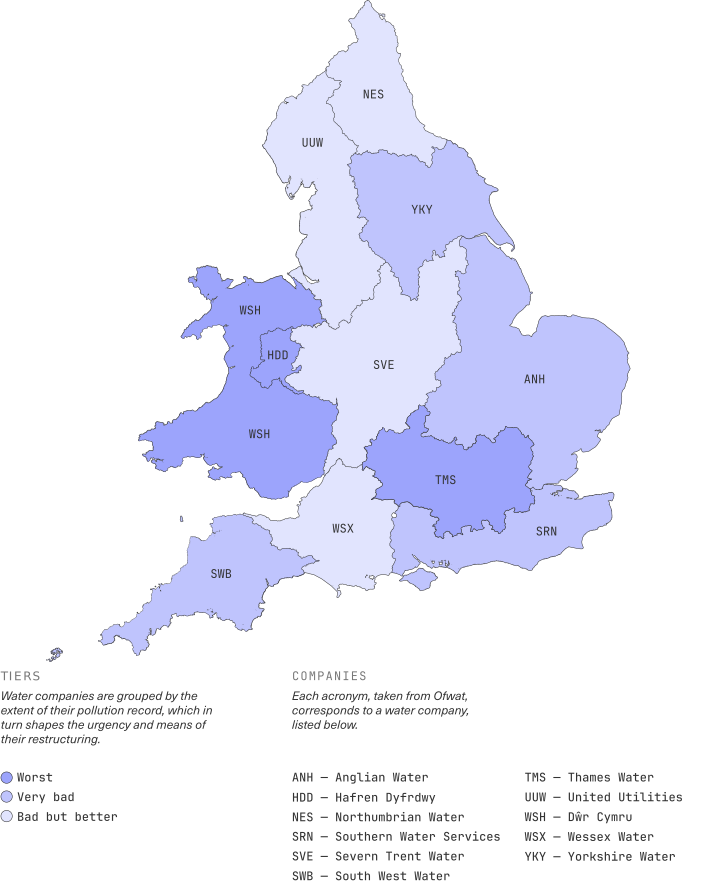
Public ownership is what 90 per cent of the world does and what 82 per cent of the British public want because they see the failures of privatisation. Based on Environment Agency rankings, this report groups English water companies into three categories. These categories additionally inform the approach that should be taken to them.
They are:
[.box][.box-header]Box 1: Good governance in modern publicly owned companies[.box-header][.box-paragraph]Three large water companies in Europe illustrate the modern governance of publicly owned companies:[.box-paragraph][.box-paragraph]Groningen Waterbedrijf in the Netherlands has been publicly owned since its establishment in the nineteenth century and is required to never be privatised by Dutch law.[21] It has a six-person board. Four directors are chosen by the city council (the shareholder), and two directors are chosen by the workers council.[22][.box-paragraph][.box-paragraph]Berliner Wasserbetriebe was made public after privatisation failed in 2013. It was bought back from the private companies before their franchise expired, with RWE paid €618 million for its 24.95 per cent share and Veolia €590 million for its 24.95 per cent share to end the contract early. It now has a 16-person supervisory board with eight members chosen by the Berlin city council and eight elected by workers, which in turn elects an executive board.[23][.box-paragraph][.box-paragraph]Eau de Paris was made public in 2009 after a failed privatisation. It was taken back into public ownership as the franchise expired with the private companies Veolia and Suez (similar to the franchise model of English train operating companies) paying £0 compensation. Since then, on the board of directors of Eau de Paris are 13 directors chosen by city councillors, two elected by workers, three representatives of consumer or environmental groups and two non-voting, city-appointed experts.[24][.box-paragraph][.box-paragraph]All these public companies borrow to invest in infrastructure, without adding to national debt, under their countries’ fiscal rules, using the methods in the European System of Accounts (see Section 7 below).[.box-paragraph][.box]
Thames Water and South East Water should be stripped of their licences and be put into special administration. After this, an orderly transfer of assets should be made to a new publicly owned company, just as Railtrack passed to Network Rail after a year of special administration at a cost of £70 million.[25] Shareholders should be paid nothing. Most have already written off their investments.[26] Secured creditors should also be paid close to £0, because markets have already priced the debt as junk and the repair costs for Thames Water’s broken sewage and pipe networks to 2029 alone are over £23 billion,[27] exceeding the £20 billion debts. The company has systematically breached its primary statutory duties to keep sewage treatment and pipes in good repair, and shareholders and creditors have profited from this pollution. Creditors might well sue — likely led by the American fund Elliott Management, which is well known for its litigious business strategy. However, creditors are very likely to lose in court because, in law, they are due only “appropriate value”, not “market value” for their claims. This measure prioritises statutory duties over creditors’ interests.[28] By contrast, all employees and their pensions should be fully protected and transferred to a new publicly owned company.[29] The new company’s board should include directors elected by workers (who are among water’s leading experts) and directors elected by mayors or by council leaders, until there are elected mayors (to represent bill payers). When a water company is acquired for £0, there is no additional debt on anyone’s books, except the polluters.
Anglian, Yorkshire, Southern and South Western Water have, after Thames Water, the worst pollution records and are likely to have repair costs exceeding debt. They should be brought into public ownership in an orderly process. First, the regulator can immediately require all companies to state the repair costs to fully meet legal duties to (i) treat all sewage twice before it can be safely released into waterways and (ii) repair pipes to stop leaks that may threaten supply in droughts. This should be released in three months.[30] It should be used to assess the fair level of compensation. Second, if there is no reasonable prospect that the companies will comply with their statutory duties, they should be put in special administration, have assets transferred to new public sector bodies, and their creditors and shareholders should receive something closer to £0 compensation.
United Utilities, Severn Trent, Northumbrian and Wessex have unacceptable pollution levels and leaks but are in better shape than others in England. Then there are four other smaller but significant drinking-water only companies: these overlap with the water and sewage companies shown in Figure 1. Based on current market capitalisations, discounting 50 per cent to reflect their monopolies, the “polluter pays” principle and high repair costs (without knowing the real sum yet), fair compensation could be estimated at £12 billion to take them into public ownership, with payment spread over a number of years. Moody’s, the rating agency, which was not paid by water companies, estimated £14.5 billion in 2019, before the increased levels of failure in the coming years.[31] This compares to the upper bound of £20.973 billion in wastewater privatisation costs over five years for water and sewerage companies. So, even over three years, public ownership saves bill payers up to £0.58 billion (minus public financing costs), after an initial £12 billion investment. The UK should adopt international and European accounting standards, so that any debt that these publicly owned companies have is not artificially treated as national debt.[32] This is not changing the core of the UK fiscal rules (to balance the budget and for national debt to fall by 2029) but will release the Treasury’s handbrake on investment-led growth in real household wealth.[33] This will enable much more infrastructure investment and real economic growth, from housing to energy and transport.
[.fig][.fig-title]Figure 1: The Worst, the Very Bad and the Bad but Better Water and Wastewater Companies in England and Wales[.fig-title][.fig-subtitle]Map of appointed wastewater company boundaries in England and Wales[.fig-subtitle][.fig]
[.notes]Source: “Appointed Wastewater Boundaries”, Stream Water Data, 2025.[.notes]
The rest of the report runs as follows: Section 2 sets out the brief historical, statistical and theoretical context of English (privatised) water, Welsh (mutualised) water and Scottish, Northern Irish and European (publicly owned) water. Section 3 explains how the special administration process operates for the failed companies. Section 4 sets out a table of water companies and estimates the likely costs to bring all big companies into public ownership through special administration or an Act of Parliament. Section 5 explains how the creditors might sue and why they will likely lose, whether in tort, judicial review, human rights or investment treaty challenges. Section 6 summarises the new systems of good governance for public services (with worker directors, and service-user directors in boardrooms) which can and should be adopted in all companies, whatever their ownership structure. Section 7 explains the problems, myths and conflicts in two other reform proposals that advocate re-privatisation or mutualisation and expands upon the fiscal and political reality. Section 8 concludes.
[1] Kate Whannel, “Burnham promises more devolution and public control of essential services”, BBC News, 1 September 2026, https://www.bbc.co.uk/news/articles/cx2z528rdp6o
[2] E. Pérard, “Water supply: Public or private?”, Policy and Society, 2017, vol. 27(3), p. 193 — finding as few as 17 per cent of the OECD population served by private water companies; David Hall and E. Lobina, “Water privatisation”, Public Services International Research Unit WP, April 2008, 4: “Around 90 per cent of the 400 largest cities in the world, with populations of over 1 million, are served through public sector operators.”; E. McGaughey, “Is Public Ownership or Privatisation Better? Law, Economic Theories, and How Data Helps”, in G. Sitaraman, M. Ricks and E. McGaughey, The Cambridge Handbook on Networks, Platforms and Utilities, Cambridge University Press 2026, Ch. 2, p. 31, Table 2.2 (or part 3, Figure 3 on SSRN), showing over 90 per cent of OECD countries with predominantly public ownership of water.
[3] “Most Britons think water and energy companies should be nationalised”, YouGov, 27 May 2026.
[4] Oliver Hart, Andrei Shleifer and R. Vishny, “The proper scope of government: theory and application to prisons”, Quarterly Journal of Economics 1127, 1997, vol. 112(4) p. 113. See footnote 4, equating outsourcing in an “incomplete contract” to regulation; A Shleifer, “State versus Private Ownership”, Journal of Economic Perspectives, 1998, vol. 12(4), p. 133.
[5] See Section 7. This was favoured by Sunak’s government, Rachel Reeves, Steve Reed, Dan Mead at Labour Together, and Thames Water.
[6] E. Stallard and J. Fisher, “England sewage spills hit record 3.6m hours last year”, BBC, 27 March 2025.
[7] A. Kersley, “Water firms in England and Wales lost more than 1tn litres from leaks last year”, Guardian, 8 September 2024.
[8] “PR24 final determinations: City briefing”, Ofwat, 19 December 2024, p. 12. (Increase in returns on capital £11.057bn to £22.047.)
[9] Namely £22.047bn ÷ 5 years = £4.4bn a year ÷ roughly 25 million households = £176 a year per household. This assumes a public ownership counterfactual in which bills and expenditures are unchanged and in which capital expenditure is financed pay-as-you-go by bills and foregone subsidies. (Of this £22 billion, £5 billion is a return on new PR24 investment, which cannot so easily be financed pay-as-you-go, so this figure is an upper bound.) It is important to note that at privatisation water companies were given state aid to be debt free. Borrowing since has primarily funded dividends: K Yearwood, “The privatised water industry in the UK. An ATM for investors”, September 2018, PSIRU, 21. Also D Hall and E Lobina, “Clean water: A case for public ownership”, UNISON, June 2024, Chs 6, 14. Residential customers comprise roughly three quarters of industry revenue, so the notional £176 increase in bills per household includes both the direct household bill increase and the bill increases of commercial customers who are assumed to pass this cost through to households. Five per cent of the total is attributable to water-only companies.
[10] D. Jordan, “Water investors have withdrawn billions, says research”, BBC News, 20 May 2024. Ofwat argued the true figure is £52bn, which is not adjusted for inflation. It is unclear why Ofwat would prefer a non-adjusted figure.
[11] See Stanley Root, “A financial history of the UK water industry since privatization”, 2025, slide 6, first chart, showing debt interest exceeding shareholder returns. Note that Root’s figures are not adjusted for inflation as David Hall’s calculation of £85.2bn is.
[12] Gill Plimmer, “The fight to save England’s rivers”, Financial Times, 22 August 2026. Also L. Barr, “UK water firms drowning in £65bn of debt with cost of repayments set to soar due to inflation (but they're still paying shareholders huge dividends)”, This is Money, 2023.
[13] J. Clover, “Water firms in drought-hit UK flogged 35 reservoirs in five years -— and built just two”, Mirror, 2022
[14] See Section 7. This is favoured by the Good Growth Foundation.
[15] There are 1500 drinking water cooperatives in Denmark, serving a minority of the population, but unlike in Wales wastewater and sewage is all publicly owned: “Europe’s Water in Figures”, EurEau, 2026, p. 17, Figures 10 and 11.
[16] Water Industry Act 1991 s 35B(1)(b) allows Ofwat to require governance changes in all water companies, private, mutual, or public.
[17] “Watchdog blocks Kelda plans for Yorkshire Water”, Guardian, 25 July 2000.
[18] “European System of Accounts”, Eurostat, 2010, p. 7, para 1.34, “The distinction between market and non-market activity is an important one. An entity controlled by government, which is shown to be a market corporation, is classified in the corporation sector, outside the general government sector. Thus, the deficit and debt levels of the corporation will not be part of the general government deficit and debt.”
[19] E.g. HM Treasury, “Charter of Budget Responsibility”, Autumn 2025, pp. 7-8, paras 3.4 and 4.7.2, updated to say the key measure is “Public Sector Non-Financial Liabilities” excluding Public Corporations (PSNFL ex PCs).
[20] S. Fleming, E. Dunkley and M. McDougall, “Ease borrowing curbs for development schemes, gilt investors urge Reeves”, Financial Times, 8 February 2026.
[21] Drinkwateret, 2009, arts 1 and 15-16. Also, Netherlands v Essent NV (2013) C 105/12 (on electricity).
[22] Waterbedrijf Groningen: Statuten, 2020, art 20(5)-(6).
[23] See Berliner Wasserbetriebe, “Supervisory Board Members”, https://www.bwb.de/en/1713.php
[24] Eau de Paris, Board of Directors, 2025.
[25] A. Zea, ‘‘Railtrack administration costs not excessive’’, Accountancy Age, 24 June 2003.
[26] E.g. G. Plimmer, “USS warns on future investments after Thames Water loss”, Financial Times, 25 July 2024
[27] Anna Isaac, “Thames Water supply ‘on knife-edge’ with £23bn repairs needed”, Guardian, 17 November 2024. Even this will not comply with the legal duties.
[28] Water Industry (Special Administration) Regulations 2024 reg 22 and reg 40.
[29] This is partly done already in law: Transfer of Undertakings (Protection of Employment) Regulations 2006 prevents most changes to job terms on transfer of assets. The Pensions Act 2004 ss 107-119 create a Pension Protection Fund for defined benefit pensions.
[30] This appears to be the time it took KKR to evaluate Thames Water’s position. KKR submitted its bid in February 2025 (E. Graham and A. Roach, CNBC, 19 February 2025). It pulled out in June 2025 (J Kollewe and J Jolly, Guardian, 3 June 2025; Gill Plimmer, “Thames Water paid £20mn to cover KKR’s due diligence for abortive bid”, FT, 25 October 2025.)